
Abstract
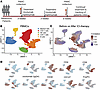
Immune checkpoint inhibitors (ICIs) such as anti–PD-1 and anti–CTLA-4 antibodies are used to induce an immune response against many types of tumors. However, ICIs often also induce autoimmune responses, referred to as immune-related adverse events (irAEs), which occur unpredictably and at varying levels of severity. We utilized high-dimensional immunophenotyping of longitudinal blood samples from patients with metastatic melanoma treated with combination anti–PD-1/CTLA-4 therapy in a clinical trial to characterize alterations in immune profiles induced by combination ICI therapy and to identify immune features associated with severe irAE development. T cell profiling highlighted that ICI therapy induces prominent expansions of activated, CD38hi CD4+ and CD8+ T cells, which are frequently bound by the therapeutic anti–PD-1 antibody, as well as substantial changes in Treg phenotypes. However, neither the baseline frequency nor the extent of expansion of these cell populations was associated with severe irAE development. Rather, naive CD4+ T cell abundance pretreatment was significantly associated with development of severe irAEs and with the number of irAEs developed. These results indicate the abundance of naive CD4+ T cells as a predictive feature for the development of severe irAEs following combination ICI therapy.
Authors
Kathryne E. Marks, Alice Horisberger, Mehreen Elahee, Ifeoluwakiisi A. Adejoorin, Nilasha Ghosh, Michael Postow, Laura Donlin, Anne R. Bass, Deepak A. Rao
This file is in Adobe Acrobat (PDF) format. If you have not installed and configured the Adobe Acrobat Reader on your system.
Having trouble reading a PDF?
PDFs are designed to be printed out and read, but if you prefer to read them online, you may find it easier if you increase the view size to 125%.
Having trouble saving a PDF?
Many versions of the free Acrobat Reader do not allow Save. You must instead save the PDF from the JCI Online page you downloaded it from. PC users: Right-click on the Download link and choose the option that says something like "Save Link As...". Mac users should hold the mouse button down on the link to get these same options.
Having trouble printing a PDF?
- Try printing one page at a time or to a newer printer.
- Try saving the file to disk before printing rather than opening it "on the fly." This requires that you configure your browser to "Save" rather than "Launch Application" for the file type "application/pdf", and can usually be done in the "Helper Applications" options.
- Make sure you are using the latest version of Adobe's Acrobat Reader.


