
Abstract
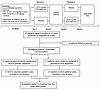
BACKGROUND Dichloroacetate (DCA) is an orally administered structural analog of pyruvate, an endogenous pyruvate dehydrogenase kinase inhibitor.METHODS We conducted a phase III multicenter trial in 34 children with pyruvate dehydrogenase complex deficiency (PDCD). Participants were randomly allocated to 4 months of treatment with DCA or a placebo, followed by a 1-month washout period and crossover to the alternate arm, and could continue into an open-label extension period. DCA dosing was predetermined by pharmacogenomic analysis of GSTZ1, which modulates DCA metabolism. The primary endpoint was the observer-reported outcomes motor domain (ObsROmotor) score. Additional assessments evaluated motor function, plasma lactate levels, and survival.RESULTS Chronic DCA was well tolerated and safe. The primary endpoint, ObsROmotor, was not statistically significantly different between the treatment and placebo groups (P = 0.512). However, longer-term treatment, including the open-label extension, showed a statistically significant treatment effect (P = 0.002), especially in participants with higher baseline motor impairment (ObsROmotor ≥ 8; P = 0.001). DCA decreased plasma lactate –0.48 (0.82) mmol/L (–20%; P = 0.006). Survival of participants was significantly greater than that of a natural history cohort (log-rank P = 0.027).CONCLUSION Longer-term treatment with DCA, dosed based on GSTZ1 haplotype, is safe and was associated with a statistically significant improvement in patient motor function, plasma lactate, and survival.FUNDING NIH (R01FD005407; R42HD089804), University of Florida Department of Medicine, Saol Therapeutics.
Authors
Peter W. Stacpoole, Jose E. Abdenur, Jirair K. Bedoyan, Lorenzo Botto, Gregory M. Enns, Marni J. Falk, Rebecca Ganetzky, Cheryl Garganta, Kevin Glinton, Andrea Gropman, Sharon Hamm, Eugenia Henry, Nicola Longo, Richard Neiberger, Russell P. Saneto, Fernando Scaglia, Sub H. Subramony, Jerry Vockley, Richard E. Wagner
This file is in Adobe Acrobat (PDF) format. If you have not installed and configured the Adobe Acrobat Reader on your system.
Having trouble reading a PDF?
PDFs are designed to be printed out and read, but if you prefer to read them online, you may find it easier if you increase the view size to 125%.
Having trouble saving a PDF?
Many versions of the free Acrobat Reader do not allow Save. You must instead save the PDF from the JCI Online page you downloaded it from. PC users: Right-click on the Download link and choose the option that says something like "Save Link As...". Mac users should hold the mouse button down on the link to get these same options.
Having trouble printing a PDF?
- Try printing one page at a time or to a newer printer.
- Try saving the file to disk before printing rather than opening it "on the fly." This requires that you configure your browser to "Save" rather than "Launch Application" for the file type "application/pdf", and can usually be done in the "Helper Applications" options.
- Make sure you are using the latest version of Adobe's Acrobat Reader.


