
Abstract
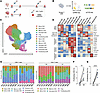
BACKGROUND IL-7 is a critical cytokine in T cell development, survival, and homeostasis. Previous preclinical and clinical studies reported that IL-7 treatment increased T cell counts, but its effect on peripheral blood T cells in cancer patients and molecular mechanisms have not been explored.METHODS We investigated effects of long-acting recombinant human IL-7 conjugated to a hybrid IgD/IgG4 Fc domain (rhIL-7-hyFc) on peripheral T cells in patients with advanced solid tumors. Peripheral blood samples were collected before and after treatment, followed by analysis through single-cell transcriptomics and flow cytometry.RESULTS We found that rhIL-7-hyFc induced marked expansion of proliferating T cells, and promoted transcriptional changes associated with immune activation, cell cycle progression, and antiapoptosis. Trajectory analysis revealed that posttreatment T cells had distinct transcriptional states enriched for cytokine- and TCR-mediated signaling pathways. Notably, a second dose administered after 3 weeks yielded diminished proliferation and minimal transcriptional changes, which were independent of antidrug antibody or CD127 downmodulation. Examination of elements of the IL-7 signaling pathway revealed intact proximal signaling (e.g., STAT5 phosphorylation) but downregulation of distal elements, including PIM-1 kinase and c-Myc.CONCLUSIONS Our results demonstrate that rhIL-7-hyFc induces robust peripheral T cell expansion and activation in patients with solid tumors, supporting its potential use for lymphopenic patients treated with cancer immunotherapy.TRIAL REGISTRATION ClinicalTrials.gov NCT03478995 and NCT03619239.FUNDING National Research Foundation of Korea (NRF-2022R1A2C3007292 and RS-2024-00439160), Ministry of Food and Drug Safety (RS-2025-02213409), and the Korea Health Technology R&D Project through the Korea Health Industry Development Institute (RS-2025-25460003).
Authors
Hocheol Jang, Jeong Yeon Kim, Sojeong Kim, Heewon Kim, Mi Sun Byun, Myung Ah Lee, Jong Hee Chang, Do-Hyun Nam, Tae Won Kim, Sin-Soo Jeun, Joo Hyuk Sohn, Su-Hyung Park, Eui-Cheol Shin
This file is in Adobe Acrobat (PDF) format. If you have not installed and configured the Adobe Acrobat Reader on your system.
Having trouble reading a PDF?
PDFs are designed to be printed out and read, but if you prefer to read them online, you may find it easier if you increase the view size to 125%.
Having trouble saving a PDF?
Many versions of the free Acrobat Reader do not allow Save. You must instead save the PDF from the JCI Online page you downloaded it from. PC users: Right-click on the Download link and choose the option that says something like "Save Link As...". Mac users should hold the mouse button down on the link to get these same options.
Having trouble printing a PDF?
- Try printing one page at a time or to a newer printer.
- Try saving the file to disk before printing rather than opening it "on the fly." This requires that you configure your browser to "Save" rather than "Launch Application" for the file type "application/pdf", and can usually be done in the "Helper Applications" options.
- Make sure you are using the latest version of Adobe's Acrobat Reader.


