
Research ArticleAIDS/HIVImmunologyInfectious disease
Open Access |  10.1172/jci.insight.193752
Coadministration of rapamycin with a DNA/MVA SIV vaccine improves memory CD8+ T cell response
Shanmugalakshmi Sadagopal,1 Kasey Stokdyk,1 Suefen Kwa,1 Rahul Basu,1 Sailaja Gangadhara,1 Rafi Ahmed,2 Smita S. Iyer,1 Koichi Araki,2 and Rama Rao Amara1,2
1Emory Vaccine Center, Emory National Primate Research Center, and
2Department of Microbiology and Immunology, Emory University, Atlanta, Georgia, USA.
Find articles by Sadagopal, S. in: PubMed | Google Scholar
1Emory Vaccine Center, Emory National Primate Research Center, and
2Department of Microbiology and Immunology, Emory University, Atlanta, Georgia, USA.
Find articles by Stokdyk, K. in: PubMed | Google Scholar
1Emory Vaccine Center, Emory National Primate Research Center, and
2Department of Microbiology and Immunology, Emory University, Atlanta, Georgia, USA.
Find articles by Kwa, S. in: PubMed | Google Scholar
1Emory Vaccine Center, Emory National Primate Research Center, and
2Department of Microbiology and Immunology, Emory University, Atlanta, Georgia, USA.
Find articles by Basu, R. in: PubMed | Google Scholar
1Emory Vaccine Center, Emory National Primate Research Center, and
2Department of Microbiology and Immunology, Emory University, Atlanta, Georgia, USA.
Find articles by Gangadhara, S. in: PubMed | Google Scholar
1Emory Vaccine Center, Emory National Primate Research Center, and
2Department of Microbiology and Immunology, Emory University, Atlanta, Georgia, USA.
Find articles by Ahmed, R. in: PubMed | Google Scholar
1Emory Vaccine Center, Emory National Primate Research Center, and
2Department of Microbiology and Immunology, Emory University, Atlanta, Georgia, USA.
Find articles by Iyer, S. in: PubMed | Google Scholar
1Emory Vaccine Center, Emory National Primate Research Center, and
2Department of Microbiology and Immunology, Emory University, Atlanta, Georgia, USA.
Find articles by Araki, K. in: PubMed | Google Scholar
1Emory Vaccine Center, Emory National Primate Research Center, and
2Department of Microbiology and Immunology, Emory University, Atlanta, Georgia, USA.
Find articles by
Amara, R.
in:
PubMed
|
Google Scholar
|

Published April 23, 2026 - More info
JCI Insight. 2026;11(11):e193752. https://doi.org/10.1172/jci.insight.193752.
© 2026 Sadagopal et al. This work is licensed under the Creative Commons Attribution 4.0 International License. To view a copy of this license, visit http://creativecommons.org/licenses/by/4.0/.
Received: March 24, 2025; Accepted: April 8, 2026

-
Results
Study design. The primary objective of our study was to determine whether inhibiting mTOR during the T cell expansion and effector-to-memory transition phases following vaccination enhances the CD8+ and CD4+ T cell memory induced by vaccination in the setting of a DNA prime, MVA boost (DM) SIV vaccine platform. To this end, male rhesus macaques were treated with rapamycin from day –3 to day +28, either during MVA boosts alone (DMR; n = 10) or during both the DNA primes and MVA boosts (DRMR; n = 10) (Figure 1A). Vaccinated animals not treated with rapamycin (DM; n = 10) served as vaccine-only controls, and unvaccinated animals treated with rapamycin served as an additional set of rapamycin-only controls (n = 4). To achieve concentrations of 5–15 ng rapamycin/mL blood (as generally seen in transplant recipients, ref. 22), animals were administered a loading dose of 0.03 mg/kg rapamycin subcutaneously on day –3. Subsequently, drug levels were monitored weekly, and dosage was adjusted resulting in trough levels of 5–15 ng/mL throughout the 32-day treatment period (Figure 1B). We monitored blood chemistry, liver enzymes, kidney enzymes, and hematology following the second MVA. Rapamycin treatment did not significantly alter any of these (Supplemental Figure 1; supplemental material available online with this article; https://doi.org/10.1172/jci.insight.193752DS1). Starting on week 49, we administered intrarectal challenges of SIVmac251 weekly to all animals, including unvaccinated controls (n = 10), to evaluate protection.
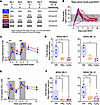 Figure 1
Rapamycin treatment during immunization with DNA/MVA SIV vaccine reduces contraction of Gag-CM9 tetramer+ CD8+ T cells. (A) Macaques were immunized with DNA (D) prime/MVA (M) boost SIV vaccine and treated with rapamycin (Rapa). (B) Rapa concentrations in blood for animals in DMR (n = 10) and DRMR group (n = 10). Target concentration range (5–15 ng/mL) is shown in gray. (C) Geometric means of frequencies of Gag-CM9–specific tetramer+ CD8+ T cells measured temporally after MVA boosts in Mamu-A*01 macaques (n = 4/group). (D) Fold decrease in frequencies of Gag-specific tetramer+ cells from peak to memory in the vaccinated groups at weeks 5 and 12 after the second MVA boost. (E) Geometric means of frequencies of SIV-specific IFN-γ+CD8+ T cells measured temporally after MVA boosts. (F) Fold decrease in frequencies of IFN-γ on SIV-specific CD8+ T cells at week 5 and week 12 after the second MVA immunization (n = 10/group). Mamu-A*01 animals are indicated by closed symbols. *P < 0.05; ***P < 0.001 by 1-way ANOVA; 2-way ANOVA multiple comparisons tests was used to compare the fold change between groups.
Rapamycin treatment reduces contraction of vaccine-induced CD8+ T cells. To determine whether rapamycin during vaccination regulated the magnitude of the CD8+ T cell response, we assessed frequencies of Gag-CM9–specific tetramer+ cells in Mamu A*01+ animals (n = 4/vaccine group; Figure 1, C and D, and Supplemental Figure 2A) and frequencies of IFN-γ+ Gag- and Env-specific CD8+ T cells by intracellular cytokine staining (ICS) at peak effector and memory time points after MVA boosts (Figure 1, E and F, Supplemental Figure 2B). Consistent with rapamycin-induced regulation of cell proliferation, CD8+ T cell response peaked at week 2 with rapamycin treatment relative to week 1 in vaccinated macaques without rapamycin (Figure 1, C and E). Strikingly, after MVA2, the contraction of Gag-CM9 tetramer+ cells from peak to memory was lower in rapamycin groups (1.3-fold at week 5 and 2.8-fold at week 12 in DRMR, and 1.5-fold at week 5 and 4.7-fold at week 12 in DMR) relative to DM (3.8-fold at week 5 and 10.7-fold at week 12) (Figure 1D). Correspondingly, SIV-specific IFN-γ+CD8+ T cell responses as assessed by ICS in all animals irrespective of Mamu A*01 status showed a similar expansion and contraction kinetics of SIV Gag- and Env-specific CD8+ T cells in blood after MVA1 and MVA2 (Figure 1E and Supplemental Figure 1B). Again, the magnitude of peak IFN-γ+CD8+ T cells was not altered by rapamycin, but the contraction of effector CD8+ T cells showed a significant decrease in the group that was treated with rapamycin at the DNA prime and MVA boost, which resulted in a trend for higher magnitude of memory IFN-γ+CD8+ responses (Figure 1, E and F).
Rapamycin treatment enhances development of a central memory phenotype with enhanced survival capacity on SIV-specific CD8+ T cells. Since rapamycin improves the longevity of virus-induced memory CD8+ T cells (9), we next sought to understand phenotypic features of vaccine-induced CD8+ T cells. To this end, we quantified expression of Bcl2 (marker for increased survival capacity), CCR7 (marker for lymph node homing potential and Tcm cells), and CD127 (marker for long-lived memory T cells) on vaccine-induced CD8+ T cells. Consistent with the enhancement of CD8+ T cell memory with rapamycin, levels of Bcl2 on Gag-CM9 tetramer+ cells and IFN-γ+ SIV-specific CD8+ T cells (Figure 2, A and B, and Supplemental Figure 3A), and CD127 on IFN-γ+ SIV-specific CD8+ T cells after MVA boost was higher with rapamycin (Figure 2C).
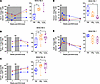 Figure 2
Rapamycin treatment enhances development of central memory phenotype with enhanced survival capacity on SIV-specific CD8+ T cells. (A) Geometric means of Bcl2+ cells on Gag-CM9 tetramer+ CD8+ T cells measured temporally after the second MVA boost in Mamu-A*01 macaques (n = 4/group) and individual data at MVA2 week 5. (B) Median frequencies of Bcl2 on Gag-stimulated IFN-γ+CD8+ T cells measured temporally after MVA immunizations in PBMCs of vaccinated animals (n = 10/group) and individual data at MVA2 week 5. (C)Median frequencies of CD127 on Gag-stimulated IFN-γ+CD8+ T cells measured temporally after MVA immunizations in PBMCs of vaccinated animals and individual data at MVA2 week 12. (D) Geometric means of perforin on Gag-CM9–specific tetramer+ cells measured temporally after MVA immunizations in Mamu-A*01 macaques (n = 4/group) and individual data at MVA2 week 1. (E) Geometric means of granzyme B (GzB+) on Gag-CM9–specific tetramer+ cells measured temporally after MVA immunizations in Mamu-A*01 macaques (n = 4/group) and individual data at MVA2 week 1. Mamu-A*01 animals are indicated by closed symbols. *P < 0.05 by 1-way ANOVA; 2-way ANOVA multiple comparisons tests was used to compare the fold change between groups.
We observed a trend for increase in CCR7 expression on tetramer+ CD8+ T cells in rapamycin-treated macaques (Supplemental Figure 3, A and B). In contrast to their expression on vaccine-induced CD8+ T cells, Bcl2 and CD127 expression on total CD8+ T cells was similar across vaccine groups, indicating the effects of rapamycin were specific to vaccine-induced CD8+ T cells (Supplemental Figure 3D). Thus, rapamycin enhanced phenotypic features of Tcm cells. Correspondingly, assessment of cytolytic markers perforin and granzyme B (markers for cytotoxic effector T cells) revealed a trend for lower expression on Gag-CM9 tetramer+ cells in rapamycin-treated macaques (Figure 2, D and E).
Viral control and survival was enhanced in rapamycin-treated macaques after intrarectal SIVmac251 challenge. To assess whether the enhanced central memory phenotype of Gag-specific CD8+ T cells induced by rapamycin resulted in improved viral control, macaques were challenged intrarectally with SIVmac251 (weekly, repeat-dose). While no differences in acquisition rates were observed (Supplemental Figure 4), rapamycin-treated groups demonstrated enhanced viral control from 6–32 weeks after infection, with a 1.6–2.4 log better viral control in DMR relative to unvaccinated controls and 0.6–0.9 log viral control compared with the DM group (Figure 3A and Supplemental Figure 5). At 32 weeks after infection, enhanced viral control was observed in both rapamycin-treated vaccinated groups relative to unvaccinated controls (Figure 3A). Examination of viral loads in the gut at week 2 after infection demonstrated significantly lower vRNA copies in vaccinated macaques, with the DMR group eliciting the most robust viral control in this compartment (Figure 3B). However, viral load was not significantly lower than the DM group in either the blood or the rectum, suggesting that the addition of rapamycin does not significantly promote viral control. To delineate whether enhanced viral control resulted in preservation of CD4+ T cells, we assessed the CD4+ Tcm cells in blood and observed significantly higher Tcm in the DMR group compared with unvaccinated controls (P = 0.02, Figure 3C). In line with enhanced CD4+ T cell preservation and viral control, rapamycin-treated macaques demonstrated enhanced survival relative to untreated (control) or vaccinated, untreated (DM) macaques, with significantly higher survival rates in the DMR group compared with DM (P = 0.03) or unvaccinated controls (P = 0.02) assessed between weeks 45 and 55 after infection (Figure 3D). Thus, rapamycin treatment during DNA/MVA vaccination resulted in a higher survival rate than both controls and vaccinated, untreated animals, and enhanced set-point viral control and preservation of CD4+ Tcm counts after infection compared with controls.
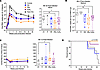 Figure 3
Better viral control and survival in rapamycin-treated macaques. Macaques were challenged intrarectally with SIVmac251 at around 29 weeks after final vaccination. (A) Left: Geometric means of SIV RNA copies/mL of plasma measured temporally (n = 10/group). Right: SIV RNA copies/mL of plasma shown individually at 32 weeks after infection. (B) SIV RNA copies in the rectum at week 2 after infection. (C) Left: Geometric means of absolute central memory CD4+ T cell counts measured temporally (n = 10/group). Right: Absolute central memory CD4+ T cell counts shown individually at 12 weeks after infection. (D) Kaplan-Meier survival curve after infection. Mamu-A*01 animals are indicated by closed symbols. *P < 0.05, **P < 0.01 by 1-way ANOVA; 2-way ANOVA multiple comparisons tests were used to compare viral loads and CD4+ central memory counts between groups at various time points, except for CCR5+ cells among Ki67+ CD4+ T cells, for which we used an unpaired, non-parametric Mann-Whitney test. Log-rank (Mantel-Cox) test was used for the survival curve.
Rapamycin reduces expression of CCR5 on vaccine-specific CD4+ T cells. To better understand the mechanistic basis of CD4+ T cell preservation after infection, we assessed CD4+ T cell responses induced after vaccination. Rapamycin treatment during DNA/MVA vaccination decreased peak frequencies (week 1 after each MVA boost) of IFN-γ–producing SIV-specific CD4+ T cells in the DRMR group compared with the DM group (Figure 4A). This decrease was not significant in the DMR group, which received rapamycin only during the MVA. However, by the memory time point (12 weeks after the second MVA), no significant differences persisted between the groups the in frequency of IFN-γ–producing SIV-specific CD4+ T cells. To assess the quality of SIV-specific CD4+ T cells, we quantified the expression of Bcl2. Nearly 100% of IFN-γ+ SIV-specific CD4+ T cells in rapamycin-treated macaques expressed Bcl2 at the 5-week memory time point after MVA boosts, a significant increase compared with untreated macaques (Figure 4B).
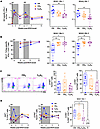 Figure 4
Rapamycin reduces expression of CCR5 on vaccine-specific CD4+ T cells. (A) Geometric means of frequencies of SIV-specific IFN-γ+CD4+ T cells measured temporally after MVA immunization in stimulated PBMCs after vaccination. Individual data points at MVA1 week 1 and MVA2 week 1 (n = 10/group). (B) Median frequencies of Bcl-2 on SIV-Gag–stimulated CD4+ T cells measured temporally after MVA immunization in stimulated PBMCs of immunized animals. Individual data at MVA1 week 5 and MVA2 week 5 (n = 10/group). (C) Representative flow plot of CCR5 and CFSE on SIV-Gag–stimulated CD4+ T cells from MVA2 week 12 time points. Frequencies of proliferating (CFSElo) CD4+ T cells, and frequencies of CCR5+ cells among proliferating (CFSElo) CD4+ T cells upon stimulation with pools of Gag and Env peptides. (D) Geometric means of Ki67+ and CCR5+ cells among total CD4+ T cells measured temporally after MVA immunizations. Individual frequencies of CCR5+ cells among Ki67+CD4+ T cells at MVA week 1. Mamu-A*01 animals are indicated by closed symbols. *P < 0.05; **P < 0.01 by 1-way ANOVA; 2-way ANOVA multiple comparisons tests were used to compare marker-positive frequencies between groups at various time points, except for CCR5+ cells among Ki67+CD4+ T cells, for which we used an unpaired, non-parametric Mann-Whitney test. For BCl2 data shown in B, we did not have data for 2 or 3 animals. For the CFSE proliferation data shown in C, we did not perform the assay on 1 animal in the DMR group due to insufficient cells. For the CCR5 expression on proliferating cells in C, we considered only samples in which proliferation was at least 1%. This excluded 6 animals (2 in DM, 3 in DMR, and 1 in DRMR).
To determine whether enhanced preservation of CD4+ T cells after infection in rapamycin-treated groups was attributable to a decrease in CCR5, we assessed CCR5 reexpression on vaccine-specific CD4+ T cells responding to restimulation using an in vitro CSFE-based proliferation assay (Figure 4C). While rapamycin treatment did not alter ex vivo proliferative capacity of CD4+ or CD8+ T cells (data not shown for CD8+ T cells), reexpression of CCR5 on proliferating SIV-specific CD4+ T cells (Figure 4C) and Ki67+ cells (Figure 4D) was significantly reduced in the DRMR group compared with the DM group. These data indicate that rapamycin treatment resulted in decreased frequencies of potential virus target cells while preserving the SIV-specific CD4+ T cell help during infection.
Rapamycin during vaccination enhances magnitude and quality of postinfection CD8+ and CD4+ T cell responses. Based on enhanced viral control, we sought to gain an understanding of postinfection T cell responses. To this end, frequencies of SIV-specific CD8+ T cells in gut and blood were quantitated by tetramer staining or ICS for IFN-γ and TNF-α temporally after infection. Peak CD8+ T cell recall responses were significantly higher in both the rapamycin-treated groups compared with the DM group in gut (Figures 5, A and B) and blood (Figure 5, C and D). Peak postinfection IFN-γ responses in blood were highly correlated with postvaccine IFN-γ frequencies in blood at memory (Figure 5E), indicating potency of rapamycin-induced vaccine-specific CD8+ memory T cells. Moreover, the frequency of Gag-CM9 tetramer–specific and Gag-specific IFN-γ+CD8+ T cells in blood were inversely correlated with viral load at week 3 after infection, suggesting the contribution of CD8+ T cells in viral control (Figure 5, F and G). We also measured SIV-specific CD4+ T cells in blood after infection. At 2 weeks after infection, frequencies of CD4+IFN-γ+ and CD4+TNF-α+ T cells were significantly higher in the DMR group as compared with unvaccinated controls (Figure 5, H and I). Overall, the frequency of IFN-γ+ cells increased over time in all groups.
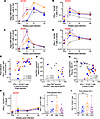 Figure 5
Enhanced magnitude and quality of postinfection recall CD8+ and CD4+ T cell responses in rapamycin-treated macaques. (A) Geometric means of frequencies of Gag-CM9–specific tetramer+ cells among total CD8+ T cells measured temporally after infection in the gut of Mamu-A*01 macaques (n = 4/group). (B) Geometric means of SIV-specific IFN-γ+ cells among total CD8+ T cells measured temporally after infection in the gut (n = 10/group). (C) Geometric means of frequencies of Gag-CM9–specific tetramer+ cells among total CD8+ T cells measured temporally after infection in the blood of Mamu-A*01 macaques (n = 4/group). (D) Geometric means of SIV-specific IFN-γ+ cells among total CD8+ T cells measured temporally after infection in the blood (n = 10/group). (E) Correlation of frequencies of postinfection SIV-specific IFN-γ+CD8+ T cells with postvaccination memory SIV-specific IFN-γ+CD8+ T cells in blood. (F) Correlation of frequencies of postinfection (PI) Gag-CM9 tetramer+ CD8+ T cells in blood on week 2 after infection with plasma viral load at week 3 after infection. (G) Correlation of SIV-specific IFN-γ+CD8+ T cells in blood with plasma viral load at week 3 after infection. (H) Left: Geometric means of SIV-specific IFN-γ+ cells among total CD4+ T cells measured temporally after infection in blood (n = 10/group). Right: Frequency of IFN-γ+ cells among total CD4+ T cells shown individually at postinfection week 2 (n = 10/group). (I) Frequency of TNF-α+ cells among total CD4+ T cells shown individually at postinfection week 2 (n = 10/group). Mamu-A*01 animals are indicated by closed symbols. *P < 0.05, **P < 0.01 by 1-way ANOVA; 2-way ANOVA multiple comparisons were used to compare cytokine-positive frequencies between groups.


