Go to The Journal of Clinical Investigation
  • About
  • Editors
  • Consulting Editors
  • For authors
  • Publication ethics
  • Publication alerts by email
  • Transfers
  • Advertising
  • Job board
  • Contact
  • Physician-Scientist Development
  • Current issue
  • Past issues
  • By specialty
    • COVID-19
    • Cardiology
    • Immunology
    • Metabolism
    • Nephrology
    • Oncology
    • Pulmonology
    • All ...
  • Videos
  • Collections
    • In-Press Preview
    • Resource and Technical Advances
    • Clinical Research and Public Health
    • Research Letters
    • Editorials
    • Perspectives
    • Physician-Scientist Development
    • Reviews
    • Top read articles

  • Current issue
  • Past issues
  • Specialties
  • In-Press Preview
  • Resource and Technical Advances
  • Clinical Research and Public Health
  • Research Letters
  • Editorials
  • Perspectives
  • Physician-Scientist Development
  • Reviews
  • Top read articles
  • About
  • Editors
  • Consulting Editors
  • For authors
  • Publication ethics
  • Publication alerts by email
  • Transfers
  • Advertising
  • Job board
  • Contact
NK cell cytotoxicity is transiently enhanced during acute malaria and modulated by the host microenvironment
Pengjun Xi, Patrick A. Sandoz, Maximilian Julius Lautenbach, Eleni Bilev, Björn Önfelt, Anna Färnert, Quirin Hammer, Christopher Sundling
View: Text | PDF
Research In-Press Preview Immunology Infectious disease Inflammation

NK cell cytotoxicity is transiently enhanced during acute malaria and modulated by the host microenvironment

  • Text
  • PDF
Abstract

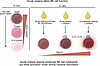
Natural killer (NK) cells are pivotal in the early immune response to Plasmodium falciparum infection, yet their functional dynamics and regulation remain incompletely understood. In a longitudinal study of malaria patients in a non-endemic setting, we observed a transient but potent activation of NK cell cytotoxicity during acute malaria, characterized by rapid granzyme B-mediated killing and elevated expression of genes associated with cytotoxicity (PRF1, GZMB, and GZMA). This heightened activity was supported by increased plasma levels of granzymes and proinflammatory cytokines, which enhanced NK cell function in vitro. However, plasma samples from clinical malaria also contained inhibitory mediators, including soluble cytokine receptors, which dampened NK cell responses. These findings reveal that the host microenvironment orchestrates a tightly regulated NK cell response that potentiates cytotoxicity during acute infection and rapidly downmodulate it after treatment. Understanding this balance between activation and suppression may inform strategies to harness NK cells for malaria control while minimizing immunopathology.

Authors

Pengjun Xi, Patrick A. Sandoz, Maximilian Julius Lautenbach, Eleni Bilev, Björn Önfelt, Anna Färnert, Quirin Hammer, Christopher Sundling

×
Problems with a PDF?

This file is in Adobe Acrobat (PDF) format. If you have not installed and configured the Adobe Acrobat Reader on your system.

Having trouble reading a PDF?

PDFs are designed to be printed out and read, but if you prefer to read them online, you may find it easier if you increase the view size to 125%.

Having trouble saving a PDF?

Many versions of the free Acrobat Reader do not allow Save. You must instead save the PDF from the JCI Online page you downloaded it from. PC users: Right-click on the Download link and choose the option that says something like "Save Link As...". Mac users should hold the mouse button down on the link to get these same options.

Having trouble printing a PDF?

  1. Try printing one page at a time or to a newer printer.
  2. Try saving the file to disk before printing rather than opening it "on the fly." This requires that you configure your browser to "Save" rather than "Launch Application" for the file type "application/pdf", and can usually be done in the "Helper Applications" options.
  3. Make sure you are using the latest version of Adobe's Acrobat Reader.

- Download (4.75 MB)

Advertisement

Copyright © 2026 American Society for Clinical Investigation
ISSN 2379-3708

Sign up for email alerts