
Submit a comment
Abstract
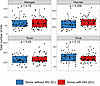
BACKGROUND Transplanting kidneys from donors with HIV to recipients with HIV has become standard clinical practice. However, donors with HIV may have higher prevalence of viral and bacterial infections and autoimmunity that could increase allograft rejection in recipients.METHODS We included deceased kidney donors (60 with HIV and 41 without HIV) who participated in a multicenter prospective study of HIV kidney transplantation between April 2018 and September 2021. Using phage immunoprecipitation sequencing, we compared the human antibody repertoire (allergens, autoantibodies, viruses, and bacterial toxins) between donors with and without HIV and evaluated their association with recipient allograft rejection. Moderated t tests were used to assess reactivity and a multivariate logistic regression model adjusted for donor sex and kidney donor profile index assessed the association between donor adenovirus reactivity and recipient allograft rejection.RESULTS Compared with donors without HIV, donors with HIV had lower BMI and were more likely to be African American. The median number of positive autoantibodies was marginally higher among donors with HIV (499 [IQR, 357, 579]) compared with that of donors without HIV (395 [IQR, 256, 538], P = 0.058). Donors with HIV additionally had significantly higher antibody reactivity to Epstein-Barr virus and cytomegalovirus (q < 0.05). Among all donors with and without HIV, antibodies against adenovirus were significantly associated with increased rejection among recipients, including after adjusting for false discovery (q < 0.05) and also adjusting for demographic factors using multivariable logistic regression (odds ratio = 4.97; 95% CI = 1.89–13.61).CONCLUSION The presence of antibodies against adenovirus infection in kidney donors with HIV may be associated with allograft rejection.TRIAL REGISTRATION ClinicalTrials.gov NCT03500315.FUNDING US NIH.
Authors
Xianming Zhu, William R. Morgenlander, Diane M. Brown, Yolanda Eby, Megan Morsheimer, Jonah Odim, Serena M. Bagnasco, Meenakshi M. Rana, Sander S. Florman, Rachel J. Friedman-Moraco, Peter G. Stock, Alexander J. Gilbert, Shikha Mehta, Valentina Stosor, Sapna A. Mehta, Marcus R. Pereira, Catherine B. Small, Michele I. Morris, Jonathan Hand, Saima Aslam, Ghady Haidar, Maricar Malinis, Carlos A.Q. Santos, Joanna Schaenman, David Wojciechowski, Karthik Ranganna, Emily Blumberg, Nahel Elias, Josa A. Castillo-Lugo, Emmanouil Giorgakis, Senu Apewokin, M. Kate Grabowski, Dorry L. Segev, Andrew D. Redd, Christine M. Durand, H. Benjamin Larman, Aaron A.R. Tobian, on behalf of the HOPE in Action investigators
Guidelines
The Editorial Board will only consider comments that are deemed relevant and of interest to readers. The Journal will not post data that have not been subjected to peer review; or a comment that is essentially a reiteration of another comment.
- Comments appear on the Journal’s website and are linked from the original article’s web page.
- Authors are notified by email if their comments are posted.
- The Journal reserves the right to edit comments for length and clarity.
- No appeals will be considered.
- Comments are not indexed in PubMed.
Specific requirements
- Maximum length, 400 words
- Entered as plain text or HTML
- Author’s name and email address, to be posted with the comment
- Declaration of all potential conflicts of interest (even if these are not ultimately posted); see the Journal’s conflict-of-interest policy
- Comments may not include figures


