
Oncology
Abstract
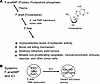
We investigated whether destroying malignant cells and the associated tumor microenvironment (TME) by focal gene therapy would broaden immune checkpoint inhibitor (ICI) effectiveness. We show that ICI antitumor activity against syngeneic (murine) triple-negative breast cancer (TNBC) was augmented when a therapeutic transgene (purine nucleoside phosphorylase, referred to here as E. coli PNP) was used to cleave fludarabine (2-fluoro-arabinofuranosyl adenine) to the anticancer purine base, 2-fluoroadenine (F-Ade). We also established strong repression of anatomically distant, non-PNP-expressing tumors being treated by the same strategy. TNBC cytoreduction was associated with decreased intratumoral PD1+ Tregs, increased granzyme B+ NK cells, elevated MKI67+ T8 cells, and rapid immune clearance. Because F-Ade works by a mechanism that destroys quiescent neoplastic and supporting cells in the microenvironment, and since resistance to ICIs depends upon an intact TME, tumor killing by this approach offers a means to sensitize refractory malignancies to immune ablation and points to broad applicability against numerous cancer subtypes.
Authors
Regina Rab, Jeong S. Hong, Brendan L.C. Kinney, Nicole C. Schmitt, William B. Parker, Adrianna Westbrook, Kelsey B. Bennion, Mandy L. Ford, Douglas H. Weitzel, Paula L. Miliani de Marval, Eric J. Sorscher, Annette Ehrhardt

Abstract
Brain metastases (BrMs) occur in approximately 30% of cancer patients, causing nearly one-fifth of cancer deaths. While immune checkpoint inhibitors (ICIs) benefit some BrM patients, responses remain highly variable. This variability partly reflects distinct histopathological growth patterns that include minimally invasive (MI) and highly invasive (HI) brain BrMs. Here we show that MI BrMs exhibit robust immune infiltration, whereas HI lesions are immunosuppressed. However, histological differentiation between MI and HI can be challenging because of subjective margin assessment. Here, using highly multiplexed spatial proteomics on 119 tumor sections from 46 patients with BrMs, we identify CHI3L1 as a key mediator of the immunosuppressive microenvironment in HI BrMs. In preclinical models, genetic deletion of CHI3L1 converts immune-cold metastases into lymphocyte-rich, ICI-responsive lesions infiltrated by granzyme B+ CD8+ T cells. In BrM patients treated with ICI, immunohistochemical quantification of CHI3L1 expression was a stronger predictor of ICI response than traditional MI/HI classification. Thus, CHI3L1 represents a promising biomarker and therapeutic target for BrMs.
Authors
Sarah M. Maritan, Elham Karimi, Matthew Dankner, Aldo Hernandez-Corchado, Miranda W. Yu, Matthew G. Annis, Yashar Aghazadeh Habashi, Morteza Rezanejad, Bridget Liu, Nebras Koudieh, Emilie Pichette, Parvaneh Fallah, Benoit Fiset, Yuhong Wei, Ali Nehme, Chun Geun Lee, Jack A. Elias, Morag Park, Yasser Riazalhosseini, Hamed Najafabadi, Kevin Petrecca, Marie-Christine Guiot, Daniela F. Quail, Logan A. Walsh, Peter M. Siegel

Abstract
Bladder cancer (BCa) mortality is mainly driven by metastatic dissemination and an immunosuppressive tumor microenvironment. Here, we identify ELN (tropoelastin), an extracellular matrix protein abundantly secreted by cancer-associated fibroblasts (CAFs), as a critical determinant of these processes and a marker of poor prognosis. ELN promotes epithelial-mesenchymal transition (EMT), facilitates lymphatic spread, and induces immune dysfunction characterized by macrophage polarization toward an M2 phenotype and T cell exhaustion. Mechanistically, ELN functions as a binding partner of TGF-β receptor 2 (TGFBR2), thereby triggering SMAD2/3-dependent TGF-β1 secretion and establishing a feed forward signaling loop. This ELN/TGFBR2/TGF-β1 axis amplifies metastatic capacity and immunosuppressive signaling, ultimately accelerating disease progression and diminishing responsiveness to immune checkpoint blockade. Functional studies in BCa organoids and murine models demonstrated that pharmacologic blockade of the ELN-TGFBR2 interaction effectively suppressed tumor metastasis and restored antitumor immunity. Collectively, our findings establish ELN as a CAF-derived driver of metastasis and immune evasion in BCa. Targeting the ELN-TGFBR2 interaction offers a promising therapeutic strategy to limit metastatic progression and enhance the efficacy of immunotherapy in this lethal disease.
Authors
Wentao Xu, Jia Gao, Shanshan Wu, Jianshang Huang, Chenchen An, Chonggui Jiang, Nianping Liu, Chen Cheng, Zihan Wang, Zijian Dong, Yuchen Xu, Jun Zhou, Hanren Dai, Xiaolei Li, Honghai Xu, Songyun Zhao, Qianwen Fan, Yang Li, Ying Dai, Li Zuo, Hua Wang
Abstract
Ubiquitin-Specific Protease 18 (USP18) is a deISGylation enzyme and antineoplastic target. To develop USP18 inhibitors, an enzymatically active human recombinant USP18 protein was engineered suitable for high-throughput screening of ~80,000 chemical compounds. Three of them substantially inhibited USP18 enzymatic activity with β-lapachone having prominent antineoplastic activity. Independent β-lapachone treatments of murine and human lung cancer cell lines statistically-significantly reduced proliferation and increased apoptosis. Gain of USP18 expression antagonized these effects. β-lapachone treatments statistically-significantly repressed lung cancer xenograft growth. β-lapachone increased reactive oxygen species (ROS), but antineoplastic effects occurred at dosages with negligible ROS production. ROS scavenger treatments did not rescue β-lapachone effects at these concentrations, consistent with an ROS-independent mechanism. Interferon-Stimulated Response Element (ISRE) reporter assays following β-lapachone treatment activated this reporter. USP18 co-transfection antagonized this activity. β-lapachone treatments increased global ISGylation. RNA sequencing of lung cancer cells engineered with or without enhanced USP18 expression showed specific pathways affected by β-lapachone treatment. Proteomic analysis of these treated cells revealed known and new ISGylated proteins. In silico modeling identified a unique USP18 pocket where these USP18 inhibitors bind. Engineered mutation of this pocket disrupted β-lapachone activity. Taken together, β-lapachone is an antineoplastic tool compound useful for USP18 inhibitor development.
Authors
Blessing O. Ogunlade, Kevin N. Dalby, Samuel C. Okpechi, Eun Jeong Cho, Liliya Tyutyunyk-Massey, Zibo Chen, Xiuxia Liu, Joseph Ivanic, Brian Luke, Shyamal D. Desai, Yair Alfaro, Ashwini K. Devkota, Rae M. Sammons, Gilbert G. Privé, Xi Liu, Ethan Dmitrovsky
Abstract
Antibody production by B cells has emerged as an important factor in regulating anti-tumor immunity with both suppressive and promotive roles in cancer. However, the specific impact of antibody deficiency during development of pancreatic ductal adenocarcinoma (PDAC) has not been explored. To address this question, we crossed the well-established KPC mouse model to mice lacking all circulating immunoglobulin (Ig) due to genetic ablation of both Ig secretion and Ig class switching (KPC-μSAID mice). KPC-μSAID mice exhibited a two-fold acceleration in tumor formation, a two-fold reduction in median survival, and increased liver metastases versus KPC-WT control mice. Immunofluorescence analysis of pancreatic tissues from antibody-sufficient KC- and KPC-WT mice showed that IgG was predominantly localized within extracellular matrix (ECM). Furthermore, in both KC- and KPC-μSAID mice, ECM density and podoplanin+ cancer-associated fibroblasts (CAFs) were significantly reduced. In the KPC-μSAID tumor microenvironment (TME), intratumoral myeloid-derived suppressor cells (MDSC) were also increased, while CD4+ and CD8+ T cells decreased, relative to tumor-bearing KPC-WT mice, with macrophage exhibiting a mixed polarization phenotype. These findings were recapitulated in antibody-subclass-deficient, KPC-AID mice, suggesting a potentially novel function of IgG in suppressing PDAC progression, by directly or indirectly regulating pancreatic fibrosis and the density of the ECM.
Authors
Jeremy B. Foote, Sujith Sarvesh, Sameer Al Diffalha, David K. Crossman, Changde Cheng, Myng-Hee Kim, Cherlene Hardy, Julienne L. Carstens, Kyoko Kojima, Bart J. Rose, Christopher A. Klug

Abstract
Authors
Tiziana Parisi, Blanca Santibanez Ocampo, Jacob Adelman, Yuyan Cai, Marie McConkey, Christopher J. Gibson, Benjamin L. Ebert, Peter Miller, Tyler Jacks
Abstract
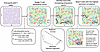
T cells are the central players in antitumor immunity, and effective tumor killing depends on their ability to infiltrate into the tumor microenvironment (TME) while maintaining normal cytotoxicity. However, late-stage tumors develop immunosuppressive mechanisms that impede T cell movement and induce exhaustion. Investigating T cell migration in human tumors in vivo could provide insights into tumor immune escape, although it remains a challenging task. In this study, we developed ReMiTT, a computational method that leverages spatial transcriptomics data to track T cell migration patterns within tumor tissue. Applying ReMiTT to multiple tumor samples, we identified potential migration trails. On these trails, chemokines that promote T cell trafficking displayed an increasing trend. Additionally, we identified key genes and pathways enriched on these migration trails, including those involved in cytoskeleton rearrangement, leukocyte chemotaxis, cell adhesion, leukocyte migration, and extracellular matrix remodeling. Furthermore, we characterized the phenotypes of T cells along these trails, showing that the migrating T cells are highly proliferative. Our findings introduce an approach for studying T cell migration and interactions within the TME, offering valuable insights into tumor-immune dynamics.
Authors
Lin Zhong, Bo Li, Zhikai Chi, Siyuan Zhang, Qiwei Li, Guanghua Xiao
Abstract
Cancer-induced bone pain (CIBP) is among the most common and debilitating symptoms in patients with bone metastasis. Current treatments are somewhat effective but have severe side effects. For the future development of safer CIBP treatment, in this study, we sought to investigate the mechanisms whereby the cancer/nerve interaction controls CIBP. We found that c-Kit, a receptor tyrosine kinase, was activated in the dorsal root ganglia (DRG) sensory neurons of mice with CIBP and that c-Kit’s sole ligand, stem cell factor (SCF), was enhanced in the bone marrow with bone metastasis. When DRGs were treated SCF or conditioned medium from high SCF-expressing cancer cells, in vitro nerve sprouting was enhanced, and this effect was abolished with c-Kit inhibitors. Mice, intrafemorally inoculated with cancer cells that had varying SCF-expression developed CIBP and enhanced peripheral nerve sprouting in an SCF-dependent manner. Downstream proteomic analysis revealed that SCF upregulated and activated fibroblast growth factor 1 (FGF1) in DRGs. When FGF1 was knocked down in DRGs, SCF-mediated nerve sprouting was prevented. Taken together, our studies demonstrate the importance of the SCF/c-Kit axis in CIBP and nerve sprouting, and identify the SCF/c-Kit/FGF1 pathway as a potential therapeutic target for CIBP.
Authors
Kelly F. Contino, Jenna Ollodart, Yang Yu, Sun H. Park, Shunsuke Tsuzuki, Kara Rollins, Tyler M. Heethouse, Joshua Chu, Laiton R. Steele, Takahiro Kimura, Jingyun Lee, Cristina M. Furdui, Lance D. Miller, Fang-Chi Hsu, Yusuke Shiozawa
Abstract
Authors
Natalie E. Andresen, Heehwa G. Son, Joongho J. Joh, Shadmehr Demehri
Development and characterization of triazole-based WDR5 inhibitors for the treatment of glioblastoma
Abstract
Glioblastoma (GBM) cancer stem cells (CSCs) contribute to tumor recurrence, treatment resistance, and dismal clinical outcomes. Genetic and pharmacological evidence suggests that the nuclear scaffolding protein WD-repeat containing protein 5 (WDR5) is a therapeutic vulnerability of the CSC population. However, previously reported WDR5 inhibitors display low permeability and are unable to penetrate the blood-brain barrier (BBB), limiting their utility in GBM. Herein, we report the structure-guided development of a novel series of triazole-based WDR5 WIN-site inhibitors designed to increase passive brain penetration. We identified triazole-based WDR5 inhibitors that are potent, passively permeable, and in some cases more brain penetrant than other scaffolds. We phenotypically assessed our novel WDR5 inhibitors in a panel of patient-derived CSC models and uncovered unique WDR5-regulated metabolic genes in GBM. We also evaluated their antiproliferative activity against CSCs both in vitro and in vivo. Finally, to identify novel combination opportunities, we screened a 2,100-compound chemical probe library and identified that the ATAD2 inhibitor BAY-850 synergizes with WDR5 inhibitors to enhance CSC killing. Our work diversifies the chemical matter targeting WDR5, clarifies the in vitro consequences of WIN-site inhibition in CSCs, and encourages the future development of next-generation WDR5 inhibitors with the potential to achieve in vivo efficacy in the brain.
Authors
Jesse A. Coker, Steven R. Martinez, Sang Hoon Han, Anthony R. Sloan, Amit Kumar Gupta, George Bukenya, Paul Polzer, James H. Ramos, Emma G. Rico, Annabella Rico, A. Abigail Lindsey, Tanvi Navadgi, Natalie Reitz, Todd Romigh, Jonathan Macdonald, Dhiraj Sonawane, Christopher M. Goins, Christopher G. Hubert, Nancy S. Wang, Feixiong Cheng, Joseph Alvarado, Samuel A. Sprowls, Justin D. Lathia, Shaun R Stauffer
No posts were found with this tag.


