
Abstract
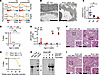
DNA repair is essential for preserving genome integrity. Podocytes, postmitotic epithelial cells of the kidney filtration unit, bear limited regenerative capacity, yet their survival is indispensable for kidney health. Podocyte loss is a hallmark of the aging process and of many diseases, but the underlying factors remain unclear. We investigated the consequences of DNA damage in a podocyte-specific knockout mouse model for DNA excision repair protein Ercc1 and in cultured podocytes under genomic stress. Furthermore, we characterized DNA damage-related alterations in mouse and human renal tissue of different ages and patients with minimal change disease and focal segmental glomerulosclerosis. Ercc1 knockout resulted in accumulation of DNA damage and ensuing albuminuria and kidney disease. Podocytes reacted to genomic stress by activating mTOR complex 1 (mTORC1) signaling in vitro and in vivo. This was abrogated by inhibiting DNA damage signaling through DNA-dependent protein kinase (DNA-PK) and ataxia teleangiectasia mutated (ATM) kinases, and inhibition of mTORC1 modulated the development of glomerulosclerosis. Perturbed DNA repair gene expression and genomic stress in podocytes were also detected in focal segmental glomerulosclerosis. Beyond that, DNA damage signaling occurred in podocytes of healthy aging mice and humans. We provide evidence that genome maintenance in podocytes is linked to the mTORC1 pathway and is involved in the aging process as well as the development of glomerulosclerosis.
Authors
Fabian Braun, Amrei M. Mandel, Linda Blomberg, Milagros N. Wong, Georgia Chatzinikolaou, David H. Meyer, Anna Reinelt, Viji Nair, Roman Akbar-Haase, Phillip J. McCown, Fabian Haas, He Chen, Mahdieh Rahmatollahi, Damian Fermin, Robin Ebbestad, Gisela G. Slaats, Tillmann Bork, Christoph Schell, Sybille Koehler, Paul T. Brinkkoetter, Maja T. Lindenmeyer, Clemens D. Cohen, Martin Kann, David Unnersjö-Jess, Wilhelm Bloch, Matthew G. Sampson, Martijn E.T. Dollé, Victor G. Puelles, Matthias Kretzler, George A. Garinis, Tobias B. Huber, Bernhard Schermer, Thomas Benzing, Björn Schumacher, Christine E. Kurschat
This file is in Adobe Acrobat (PDF) format. If you have not installed and configured the Adobe Acrobat Reader on your system.
Having trouble reading a PDF?
PDFs are designed to be printed out and read, but if you prefer to read them online, you may find it easier if you increase the view size to 125%.
Having trouble saving a PDF?
Many versions of the free Acrobat Reader do not allow Save. You must instead save the PDF from the JCI Online page you downloaded it from. PC users: Right-click on the Download link and choose the option that says something like "Save Link As...". Mac users should hold the mouse button down on the link to get these same options.
Having trouble printing a PDF?
- Try printing one page at a time or to a newer printer.
- Try saving the file to disk before printing rather than opening it "on the fly." This requires that you configure your browser to "Save" rather than "Launch Application" for the file type "application/pdf", and can usually be done in the "Helper Applications" options.
- Make sure you are using the latest version of Adobe's Acrobat Reader.


