
Abstract
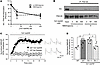
The complex and heterogeneous genetic architecture of neuropsychiatric illnesses compels us to look beyond individual risk genes for therapeutic strategies and target the interactive dynamics and convergence of their protein products. A mechanistic substrate for convergence of synaptic neuropsychiatric risk genes are protein-protein interactions (PPIs) in the N-methyl-D-aspartate receptor (NMDAR) complex. NMDAR hypofunction in schizophrenia is associated with hypoactivity of Src kinase, resulting from convergent alterations in PPIs of Src with its partners. Of these, the association of Src with PSD-95, which inhibits the activity of this kinase in the NMDAR complex, is known to be increased in schizophrenia. Here, we devised a strategy to suppress the inhibition of Src by PSD-95 by employing a cell-penetrating and Src-activating PSD-95 inhibitory peptide (TAT-SAPIP). TAT-SAPIP enhanced synaptic NMDAR currents in Src+/– and Sdy–/– mice manifesting NMDAR hypofunction phenotypes. Chronic intracerebroventricularly (ICV) injection of TAT-SAPIP rescued cognitive deficits in trace fear conditioning in Src +/– mice. Moreover, TAT-SAPIP enhanced Src activity in synaptoneurosomes derived from dorsolateral prefrontal cortex of 14 patients. We propose blockade of the Src–PSD-95 interaction as a proof of concept for the use of interfering peptides as a therapeutic strategy to reverse NMDAR hypofunction in schizophrenia and other illnesses.
Authors
Robert E. Featherstone, Hongbin Li, Ameet S. Sengar, Karin E. Borgmann-Winter, Olya Melnychenko, Lindsey M. Crown, Ray L. Gifford, Felix Amirfathi, Anamika Banerjee, AiVi Tran, Krishna Parekh, Margaret Heller, Wenyu Zhang, Robert J. Gallop, Adam D. Marc, Pragya Komal, Michael W. Salter, Steven J. Siegel, Chang-Gyu Hahn
This file is in Adobe Acrobat (PDF) format. If you have not installed and configured the Adobe Acrobat Reader on your system.
Having trouble reading a PDF?
PDFs are designed to be printed out and read, but if you prefer to read them online, you may find it easier if you increase the view size to 125%.
Having trouble saving a PDF?
Many versions of the free Acrobat Reader do not allow Save. You must instead save the PDF from the JCI Online page you downloaded it from. PC users: Right-click on the Download link and choose the option that says something like "Save Link As...". Mac users should hold the mouse button down on the link to get these same options.
Having trouble printing a PDF?
- Try printing one page at a time or to a newer printer.
- Try saving the file to disk before printing rather than opening it "on the fly." This requires that you configure your browser to "Save" rather than "Launch Application" for the file type "application/pdf", and can usually be done in the "Helper Applications" options.
- Make sure you are using the latest version of Adobe's Acrobat Reader.


