
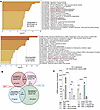
Abstract
Survival in chronic myeloid leukemia (CML) was dramatically improved by development of tyrosine kinase inhibitors (TKIs) directed to the BCR:ABL1 oncogene. Unfortunately, ~30% of patients with CML develop TKI resistance during prolonged treatment, with enhanced blast crisis risk. Oxidation Resistance 1 (Oxr1) regulates antioxidant pathways that detoxify reactive oxygen species (ROS) generated by the phagocyte-NADPH oxidase. In the current studies, we found that Oxr1 expression increased in hematopoietic stem and progenitor cells (HSPCs) from CML mice versus controls, decreased during TKI-induced remission, and rose during chronic phase relapse. Oxr1 has long and short isoforms, and we found increased short, but decreased long, Oxr1 in mice or humans during CML relapse. We determined that long Oxr1 prevents ROS accumulation in CML marrow, but short Oxr1 is a dominant negative. Previously, we found exaggerated and sustained emergency granulopoiesis in CML mice, with repeated episodes facilitating relapse during TKI remission. In the current studies, we found knocking down Oxr1 in murine marrow further accelerated CML progression during this physiologic stress. We found increased DNA-damage in HSPCs from these mice, including a BCR:ABL1 kinase-domain mutation found in TKI-resistant human CML. These studies suggest that long Oxr1 detoxifies ROS to decrease mutagenesis in CML, but aberrant short Oxr1 expression enhances progression.
Authors
Weiqi Huang, Bin Liu, Liping Hu, Chi-Hao Luan, Priyam Patel, Elizabeth Bartom, Elizabeth A. Eklund
This file is in Adobe Acrobat (PDF) format. If you have not installed and configured the Adobe Acrobat Reader on your system.
Having trouble reading a PDF?
PDFs are designed to be printed out and read, but if you prefer to read them online, you may find it easier if you increase the view size to 125%.
Having trouble saving a PDF?
Many versions of the free Acrobat Reader do not allow Save. You must instead save the PDF from the JCI Online page you downloaded it from. PC users: Right-click on the Download link and choose the option that says something like "Save Link As...". Mac users should hold the mouse button down on the link to get these same options.
Having trouble printing a PDF?
- Try printing one page at a time or to a newer printer.
- Try saving the file to disk before printing rather than opening it "on the fly." This requires that you configure your browser to "Save" rather than "Launch Application" for the file type "application/pdf", and can usually be done in the "Helper Applications" options.
- Make sure you are using the latest version of Adobe's Acrobat Reader.


