
Abstract
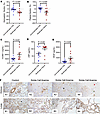
Vaso-occlusive episodes (VOEs) in the setting of hyperhemolysis can rapidly evolve into multiorgan failure in sickle cell disease (SCD). Although the mechanisms for rapid progression to multiorgan failure are unclear, a systemic vasculopathy with thrombotic microangiopathy–type features has been described. Reduced thrombomodulin (TM) function is implicated in some thrombotic microangiopathy syndromes. We observed a greater decline in platelet count and hemoglobin concentration and an increase in vascular injury biomarkers within 24 hours of admission for a VOE in 12 patients with SCD with multiorgan failure versus 12 patients without multiorgan failure. We observed decreased TM expression on the lung and kidney vasculature of 3 additional patients with SCD with multiorgan failure compared with a control patient without SCD. Transgenic SCD mice challenged with cell-free hemoglobin had reduced TM function, increased vascular injury biomarkers, and reduced renal cortical blood flow. Infusion of recombinant TM 2 or 24 hours after the challenge restored cortical blood flow and mitigated increases in vascular injury, complement activation, and tubular injury biomarkers, and protected against acute kidney and lung injury. We demonstrated that impaired TM function may be involved in the systemic vasculopathy of SCD-related multiorgan failure, and infusion of recombinant TM may restore vascular function and protect against acute organ damage.
Authors
Guohui Ren, Dustin R. Fraidenburg, Suman Setty, Jiwang Chen, Janae Gonzales, Maria Armila Ruiz, Zalaya Ivy, Najmeh Eskandari, Richard D. Minshall, James P. Lash, Victor R. Gordeuk, Santosh L. Saraf
This file is in Adobe Acrobat (PDF) format. If you have not installed and configured the Adobe Acrobat Reader on your system.
Having trouble reading a PDF?
PDFs are designed to be printed out and read, but if you prefer to read them online, you may find it easier if you increase the view size to 125%.
Having trouble saving a PDF?
Many versions of the free Acrobat Reader do not allow Save. You must instead save the PDF from the JCI Online page you downloaded it from. PC users: Right-click on the Download link and choose the option that says something like "Save Link As...". Mac users should hold the mouse button down on the link to get these same options.
Having trouble printing a PDF?
- Try printing one page at a time or to a newer printer.
- Try saving the file to disk before printing rather than opening it "on the fly." This requires that you configure your browser to "Save" rather than "Launch Application" for the file type "application/pdf", and can usually be done in the "Helper Applications" options.
- Make sure you are using the latest version of Adobe's Acrobat Reader.


