
Abstract
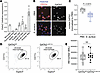
Alveolar macrophages (AMs) catabolize lipid-rich pulmonary surfactant to support gas exchange and have antiinflammatory programming to limit tissue damage in response to minor challenges. GATA transcription factors (TFs) shape immune cell fates, and GATA2 is expressed in a lung-specific manner in macrophages. GATA2 mutations and lung macrophage downregulation of GATA2 have been associated with chronic pulmonary pathologies in humans, but the role of GATA2 in coordinating AM function is not well defined. Using mice with myeloid-specific deletion of the GATA2 DNA binding C-terminal zinc finger domain, we show that GATA2 deficiency promotes enhanced inflammatory gene expression and metabolic dysfunction in AMs in response to type 2 stimuli. Although homeostatic functions of AMs remain largely intact, GATA2 deficiency increases expression of type 2 response genes during IL-33–induced inflammation. Coincident with GATA2-dependent expression of genes in metabolic pathways, Seahorse metabolic flux analysis indicates that AM metabolism is compromised in the absence of GATA2. AM GATA2-dependent gene networks are enriched for targets of TFs previously demonstrated to interact with GATA2 in other cellular contexts, including PU.1, PPARγ, and other regulators of AM function. Our data suggest that GATA2 modulates AM metabolic and transcriptomic programming to restrain responses and maintain AM identity during inflammation.
Authors
Morgan Jackson-Strong, Satarupa Ganguly, Aaron Francis, Flavia Rago, Jitendra Kanshana, Brandon A. Michalides, Lihong Teng, Omkar S. Betsur, Sonia Kruszelnicki, Karsen E. Shoger, Aaron Kim, Kay Bajpai, Amina Suleyman, Abigail Sekyere, Mika Hara, Varsha Sriram, Alok Kumar, Greg M. Delgoffe, Niranjana Natarajan, John F. Alcorn, Alison B. Kohan, Rachel A. Gottschalk
This file is in Adobe Acrobat (PDF) format. If you have not installed and configured the Adobe Acrobat Reader on your system.
Having trouble reading a PDF?
PDFs are designed to be printed out and read, but if you prefer to read them online, you may find it easier if you increase the view size to 125%.
Having trouble saving a PDF?
Many versions of the free Acrobat Reader do not allow Save. You must instead save the PDF from the JCI Online page you downloaded it from. PC users: Right-click on the Download link and choose the option that says something like "Save Link As...". Mac users should hold the mouse button down on the link to get these same options.
Having trouble printing a PDF?
- Try printing one page at a time or to a newer printer.
- Try saving the file to disk before printing rather than opening it "on the fly." This requires that you configure your browser to "Save" rather than "Launch Application" for the file type "application/pdf", and can usually be done in the "Helper Applications" options.
- Make sure you are using the latest version of Adobe's Acrobat Reader.


