
Abstract
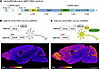
Angelman syndrome is a neurodevelopmental disorder caused by loss of the maternal UBE3A allele, the sole source of UBE3A in mature neurons owing to epigenetic silencing of the paternal allele. Although emerging therapies are being developed to restore UBE3A expression by activating the dormant paternal UBE3A allele, existing mouse models for such preclinical studies have limited throughput and utility, creating bottlenecks for both in vitro therapeutic screening and in vivo characterization. To address this, we developed the Ube3a-INSG dual-reporter knockin mouse, in which an IRES-Nanoluciferase-T2A-Sun1-sfGFP (INSG) cassette was inserted downstream of the endogenous Ube3a stop codon. The INSG model preserves UBE3A protein levels and function while enabling 2 complementary allele-specific readouts: Sun1-sfGFP and Nanoluciferase. We show that Sun1-sfGFP, a nuclear envelope–localized reporter, enables single-cell fluorescence analysis, whole-brain light-sheet imaging, and nuclear quantification by flow cytometry. Further, Nanoluciferase supports high-throughput luminescence assays for sensitive pharmacological profiling in cultured neurons and noninvasive in vivo bioluminescence imaging for pharmacodynamic assessment. By combining scalable screening, cellular analysis, and real-time in vivo monitoring in a single model, the Ube3a-INSG dual-reporter mouse provides a powerful platform to accelerate therapeutic development centered on UBE3A.
Authors
Hanna Vihma, Lucas M. James, Hannah C. Nourie, Audrey L. Smith, Siyuan Liang, Carlee A. Friar, Tasmai Vulli, Lei Xing, Dale O. Cowley, Alain C. Burette, Benjamin D. Philpot
This file is in Adobe Acrobat (PDF) format. If you have not installed and configured the Adobe Acrobat Reader on your system.
Having trouble reading a PDF?
PDFs are designed to be printed out and read, but if you prefer to read them online, you may find it easier if you increase the view size to 125%.
Having trouble saving a PDF?
Many versions of the free Acrobat Reader do not allow Save. You must instead save the PDF from the JCI Online page you downloaded it from. PC users: Right-click on the Download link and choose the option that says something like "Save Link As...". Mac users should hold the mouse button down on the link to get these same options.
Having trouble printing a PDF?
- Try printing one page at a time or to a newer printer.
- Try saving the file to disk before printing rather than opening it "on the fly." This requires that you configure your browser to "Save" rather than "Launch Application" for the file type "application/pdf", and can usually be done in the "Helper Applications" options.
- Make sure you are using the latest version of Adobe's Acrobat Reader.


