
Research ArticleGastroenterologyImmunology
Open Access |  10.1172/jci.insight.197470
Vancomycin eliminates gut deoxycholic acid, restoring ER proteostasis in ILC2s and relieving colitis
Qiuheng Tian,1 Han Liu,1,2,3 Xiang Gu,1,3 Jing Shen,1,4 Xi Yuan,1 Mengqi Zheng,1,3 Yunjiao Zhai,1 Yatai Chen,1 Penghu Han,1 Yangchun Ma,5 Wei Xin,1 Hongyue Ma,1 Yu Li,1,3 Sihan Wang,1,3 Lei Guo,6 Detian Yuan,7 Yanbo Yu,1,3 and Shiyang Li1,3,6,8
1Department of Gastroenterology, Qilu Hospital of Shandong University, Advanced Medical Research Institute, Shandong University, Jinan, China.
2Department of Gastroenterology, Qilu Hospital (Qingdao), Cheeloo College of Medicine, Shandong University, Qingdao, Shandong, China.
3Shandong Provincial Clinical Research Center for Digestive Diseases, Jinan, China.
4Shandong University Suzhou Research Institute and
5Department of Medicinal Chemistry, Key Laboratory of Chemical Biology (Ministry of Education), Cheeloo College of Medicine, Shandong University, Jinan, China.
6Children’s Hospital Affiliated to Shandong University (Jinan Children’s Hospital), Jinan, China.
7Department of Biochemistry and Molecular Biology, School of Basic Medical Sciences, and
8Key Laboratory for Experimental Teratology of Ministry of Education, Shandong University, Jinan, China.
Address correspondence to: Shiyang Li, Department of Gastroenterology, Qilu Hospital of Shandong University, Advanced Medical Research Institute, Shandong University, No. 44 Wenhuaxi Road, Jinan 250012, Shandong, China. Phone: 86.531. 8838.1719; Email: lishiyang@sdu.edu.cn. Or to: Yanbo Yu, Department of Gastroenterology, Qilu Hospital of Shandong University, No. 107 Wenhuaxi Road, Jinan 250012, Shandong, China. Phone: 86.531. 8838.1719; Email: yuyanbo2000@126.com. Or to: Detian Yuan, Department of Biochemistry and Molecular Biology, School of Basic Medical Sciences, Shandong University, No. 44 Wenhuaxi Road, Jinan 250012, Shandong, China. Phone: 86.531. 8838.1719; Email: yuandt@sdu.edu.cn. Or to: Lei Guo, Children’s Hospital Affiliated to Shandong University (Jinan Children’s Hospital), No. 23976, Jingshi Road, Jinan 250022, Shandong, China. Phone: 86.531. 8838.1719; Email: leiguo@email.sdu.edu.cn.
Authorship note: QT, HL, XG, and JS contributed equally to this work. LG, DY, YY, and SL are cosupervisors of this work.
Find articles by Tian, Q. in: PubMed | Google Scholar
1Department of Gastroenterology, Qilu Hospital of Shandong University, Advanced Medical Research Institute, Shandong University, Jinan, China.
2Department of Gastroenterology, Qilu Hospital (Qingdao), Cheeloo College of Medicine, Shandong University, Qingdao, Shandong, China.
3Shandong Provincial Clinical Research Center for Digestive Diseases, Jinan, China.
4Shandong University Suzhou Research Institute and
5Department of Medicinal Chemistry, Key Laboratory of Chemical Biology (Ministry of Education), Cheeloo College of Medicine, Shandong University, Jinan, China.
6Children’s Hospital Affiliated to Shandong University (Jinan Children’s Hospital), Jinan, China.
7Department of Biochemistry and Molecular Biology, School of Basic Medical Sciences, and
8Key Laboratory for Experimental Teratology of Ministry of Education, Shandong University, Jinan, China.
Address correspondence to: Shiyang Li, Department of Gastroenterology, Qilu Hospital of Shandong University, Advanced Medical Research Institute, Shandong University, No. 44 Wenhuaxi Road, Jinan 250012, Shandong, China. Phone: 86.531. 8838.1719; Email: lishiyang@sdu.edu.cn. Or to: Yanbo Yu, Department of Gastroenterology, Qilu Hospital of Shandong University, No. 107 Wenhuaxi Road, Jinan 250012, Shandong, China. Phone: 86.531. 8838.1719; Email: yuyanbo2000@126.com. Or to: Detian Yuan, Department of Biochemistry and Molecular Biology, School of Basic Medical Sciences, Shandong University, No. 44 Wenhuaxi Road, Jinan 250012, Shandong, China. Phone: 86.531. 8838.1719; Email: yuandt@sdu.edu.cn. Or to: Lei Guo, Children’s Hospital Affiliated to Shandong University (Jinan Children’s Hospital), No. 23976, Jingshi Road, Jinan 250022, Shandong, China. Phone: 86.531. 8838.1719; Email: leiguo@email.sdu.edu.cn.
Authorship note: QT, HL, XG, and JS contributed equally to this work. LG, DY, YY, and SL are cosupervisors of this work.
Find articles by Liu, H. in: PubMed | Google Scholar
1Department of Gastroenterology, Qilu Hospital of Shandong University, Advanced Medical Research Institute, Shandong University, Jinan, China.
2Department of Gastroenterology, Qilu Hospital (Qingdao), Cheeloo College of Medicine, Shandong University, Qingdao, Shandong, China.
3Shandong Provincial Clinical Research Center for Digestive Diseases, Jinan, China.
4Shandong University Suzhou Research Institute and
5Department of Medicinal Chemistry, Key Laboratory of Chemical Biology (Ministry of Education), Cheeloo College of Medicine, Shandong University, Jinan, China.
6Children’s Hospital Affiliated to Shandong University (Jinan Children’s Hospital), Jinan, China.
7Department of Biochemistry and Molecular Biology, School of Basic Medical Sciences, and
8Key Laboratory for Experimental Teratology of Ministry of Education, Shandong University, Jinan, China.
Address correspondence to: Shiyang Li, Department of Gastroenterology, Qilu Hospital of Shandong University, Advanced Medical Research Institute, Shandong University, No. 44 Wenhuaxi Road, Jinan 250012, Shandong, China. Phone: 86.531. 8838.1719; Email: lishiyang@sdu.edu.cn. Or to: Yanbo Yu, Department of Gastroenterology, Qilu Hospital of Shandong University, No. 107 Wenhuaxi Road, Jinan 250012, Shandong, China. Phone: 86.531. 8838.1719; Email: yuyanbo2000@126.com. Or to: Detian Yuan, Department of Biochemistry and Molecular Biology, School of Basic Medical Sciences, Shandong University, No. 44 Wenhuaxi Road, Jinan 250012, Shandong, China. Phone: 86.531. 8838.1719; Email: yuandt@sdu.edu.cn. Or to: Lei Guo, Children’s Hospital Affiliated to Shandong University (Jinan Children’s Hospital), No. 23976, Jingshi Road, Jinan 250022, Shandong, China. Phone: 86.531. 8838.1719; Email: leiguo@email.sdu.edu.cn.
Authorship note: QT, HL, XG, and JS contributed equally to this work. LG, DY, YY, and SL are cosupervisors of this work.
Find articles by Gu, X. in: PubMed | Google Scholar
1Department of Gastroenterology, Qilu Hospital of Shandong University, Advanced Medical Research Institute, Shandong University, Jinan, China.
2Department of Gastroenterology, Qilu Hospital (Qingdao), Cheeloo College of Medicine, Shandong University, Qingdao, Shandong, China.
3Shandong Provincial Clinical Research Center for Digestive Diseases, Jinan, China.
4Shandong University Suzhou Research Institute and
5Department of Medicinal Chemistry, Key Laboratory of Chemical Biology (Ministry of Education), Cheeloo College of Medicine, Shandong University, Jinan, China.
6Children’s Hospital Affiliated to Shandong University (Jinan Children’s Hospital), Jinan, China.
7Department of Biochemistry and Molecular Biology, School of Basic Medical Sciences, and
8Key Laboratory for Experimental Teratology of Ministry of Education, Shandong University, Jinan, China.
Address correspondence to: Shiyang Li, Department of Gastroenterology, Qilu Hospital of Shandong University, Advanced Medical Research Institute, Shandong University, No. 44 Wenhuaxi Road, Jinan 250012, Shandong, China. Phone: 86.531. 8838.1719; Email: lishiyang@sdu.edu.cn. Or to: Yanbo Yu, Department of Gastroenterology, Qilu Hospital of Shandong University, No. 107 Wenhuaxi Road, Jinan 250012, Shandong, China. Phone: 86.531. 8838.1719; Email: yuyanbo2000@126.com. Or to: Detian Yuan, Department of Biochemistry and Molecular Biology, School of Basic Medical Sciences, Shandong University, No. 44 Wenhuaxi Road, Jinan 250012, Shandong, China. Phone: 86.531. 8838.1719; Email: yuandt@sdu.edu.cn. Or to: Lei Guo, Children’s Hospital Affiliated to Shandong University (Jinan Children’s Hospital), No. 23976, Jingshi Road, Jinan 250022, Shandong, China. Phone: 86.531. 8838.1719; Email: leiguo@email.sdu.edu.cn.
Authorship note: QT, HL, XG, and JS contributed equally to this work. LG, DY, YY, and SL are cosupervisors of this work.
Find articles by Shen, J. in: PubMed | Google Scholar
1Department of Gastroenterology, Qilu Hospital of Shandong University, Advanced Medical Research Institute, Shandong University, Jinan, China.
2Department of Gastroenterology, Qilu Hospital (Qingdao), Cheeloo College of Medicine, Shandong University, Qingdao, Shandong, China.
3Shandong Provincial Clinical Research Center for Digestive Diseases, Jinan, China.
4Shandong University Suzhou Research Institute and
5Department of Medicinal Chemistry, Key Laboratory of Chemical Biology (Ministry of Education), Cheeloo College of Medicine, Shandong University, Jinan, China.
6Children’s Hospital Affiliated to Shandong University (Jinan Children’s Hospital), Jinan, China.
7Department of Biochemistry and Molecular Biology, School of Basic Medical Sciences, and
8Key Laboratory for Experimental Teratology of Ministry of Education, Shandong University, Jinan, China.
Address correspondence to: Shiyang Li, Department of Gastroenterology, Qilu Hospital of Shandong University, Advanced Medical Research Institute, Shandong University, No. 44 Wenhuaxi Road, Jinan 250012, Shandong, China. Phone: 86.531. 8838.1719; Email: lishiyang@sdu.edu.cn. Or to: Yanbo Yu, Department of Gastroenterology, Qilu Hospital of Shandong University, No. 107 Wenhuaxi Road, Jinan 250012, Shandong, China. Phone: 86.531. 8838.1719; Email: yuyanbo2000@126.com. Or to: Detian Yuan, Department of Biochemistry and Molecular Biology, School of Basic Medical Sciences, Shandong University, No. 44 Wenhuaxi Road, Jinan 250012, Shandong, China. Phone: 86.531. 8838.1719; Email: yuandt@sdu.edu.cn. Or to: Lei Guo, Children’s Hospital Affiliated to Shandong University (Jinan Children’s Hospital), No. 23976, Jingshi Road, Jinan 250022, Shandong, China. Phone: 86.531. 8838.1719; Email: leiguo@email.sdu.edu.cn.
Authorship note: QT, HL, XG, and JS contributed equally to this work. LG, DY, YY, and SL are cosupervisors of this work.
Find articles by Yuan, X. in: PubMed | Google Scholar
1Department of Gastroenterology, Qilu Hospital of Shandong University, Advanced Medical Research Institute, Shandong University, Jinan, China.
2Department of Gastroenterology, Qilu Hospital (Qingdao), Cheeloo College of Medicine, Shandong University, Qingdao, Shandong, China.
3Shandong Provincial Clinical Research Center for Digestive Diseases, Jinan, China.
4Shandong University Suzhou Research Institute and
5Department of Medicinal Chemistry, Key Laboratory of Chemical Biology (Ministry of Education), Cheeloo College of Medicine, Shandong University, Jinan, China.
6Children’s Hospital Affiliated to Shandong University (Jinan Children’s Hospital), Jinan, China.
7Department of Biochemistry and Molecular Biology, School of Basic Medical Sciences, and
8Key Laboratory for Experimental Teratology of Ministry of Education, Shandong University, Jinan, China.
Address correspondence to: Shiyang Li, Department of Gastroenterology, Qilu Hospital of Shandong University, Advanced Medical Research Institute, Shandong University, No. 44 Wenhuaxi Road, Jinan 250012, Shandong, China. Phone: 86.531. 8838.1719; Email: lishiyang@sdu.edu.cn. Or to: Yanbo Yu, Department of Gastroenterology, Qilu Hospital of Shandong University, No. 107 Wenhuaxi Road, Jinan 250012, Shandong, China. Phone: 86.531. 8838.1719; Email: yuyanbo2000@126.com. Or to: Detian Yuan, Department of Biochemistry and Molecular Biology, School of Basic Medical Sciences, Shandong University, No. 44 Wenhuaxi Road, Jinan 250012, Shandong, China. Phone: 86.531. 8838.1719; Email: yuandt@sdu.edu.cn. Or to: Lei Guo, Children’s Hospital Affiliated to Shandong University (Jinan Children’s Hospital), No. 23976, Jingshi Road, Jinan 250022, Shandong, China. Phone: 86.531. 8838.1719; Email: leiguo@email.sdu.edu.cn.
Authorship note: QT, HL, XG, and JS contributed equally to this work. LG, DY, YY, and SL are cosupervisors of this work.
Find articles by Zheng, M. in: PubMed | Google Scholar
1Department of Gastroenterology, Qilu Hospital of Shandong University, Advanced Medical Research Institute, Shandong University, Jinan, China.
2Department of Gastroenterology, Qilu Hospital (Qingdao), Cheeloo College of Medicine, Shandong University, Qingdao, Shandong, China.
3Shandong Provincial Clinical Research Center for Digestive Diseases, Jinan, China.
4Shandong University Suzhou Research Institute and
5Department of Medicinal Chemistry, Key Laboratory of Chemical Biology (Ministry of Education), Cheeloo College of Medicine, Shandong University, Jinan, China.
6Children’s Hospital Affiliated to Shandong University (Jinan Children’s Hospital), Jinan, China.
7Department of Biochemistry and Molecular Biology, School of Basic Medical Sciences, and
8Key Laboratory for Experimental Teratology of Ministry of Education, Shandong University, Jinan, China.
Address correspondence to: Shiyang Li, Department of Gastroenterology, Qilu Hospital of Shandong University, Advanced Medical Research Institute, Shandong University, No. 44 Wenhuaxi Road, Jinan 250012, Shandong, China. Phone: 86.531. 8838.1719; Email: lishiyang@sdu.edu.cn. Or to: Yanbo Yu, Department of Gastroenterology, Qilu Hospital of Shandong University, No. 107 Wenhuaxi Road, Jinan 250012, Shandong, China. Phone: 86.531. 8838.1719; Email: yuyanbo2000@126.com. Or to: Detian Yuan, Department of Biochemistry and Molecular Biology, School of Basic Medical Sciences, Shandong University, No. 44 Wenhuaxi Road, Jinan 250012, Shandong, China. Phone: 86.531. 8838.1719; Email: yuandt@sdu.edu.cn. Or to: Lei Guo, Children’s Hospital Affiliated to Shandong University (Jinan Children’s Hospital), No. 23976, Jingshi Road, Jinan 250022, Shandong, China. Phone: 86.531. 8838.1719; Email: leiguo@email.sdu.edu.cn.
Authorship note: QT, HL, XG, and JS contributed equally to this work. LG, DY, YY, and SL are cosupervisors of this work.
Find articles by Zhai, Y. in: PubMed | Google Scholar
1Department of Gastroenterology, Qilu Hospital of Shandong University, Advanced Medical Research Institute, Shandong University, Jinan, China.
2Department of Gastroenterology, Qilu Hospital (Qingdao), Cheeloo College of Medicine, Shandong University, Qingdao, Shandong, China.
3Shandong Provincial Clinical Research Center for Digestive Diseases, Jinan, China.
4Shandong University Suzhou Research Institute and
5Department of Medicinal Chemistry, Key Laboratory of Chemical Biology (Ministry of Education), Cheeloo College of Medicine, Shandong University, Jinan, China.
6Children’s Hospital Affiliated to Shandong University (Jinan Children’s Hospital), Jinan, China.
7Department of Biochemistry and Molecular Biology, School of Basic Medical Sciences, and
8Key Laboratory for Experimental Teratology of Ministry of Education, Shandong University, Jinan, China.
Address correspondence to: Shiyang Li, Department of Gastroenterology, Qilu Hospital of Shandong University, Advanced Medical Research Institute, Shandong University, No. 44 Wenhuaxi Road, Jinan 250012, Shandong, China. Phone: 86.531. 8838.1719; Email: lishiyang@sdu.edu.cn. Or to: Yanbo Yu, Department of Gastroenterology, Qilu Hospital of Shandong University, No. 107 Wenhuaxi Road, Jinan 250012, Shandong, China. Phone: 86.531. 8838.1719; Email: yuyanbo2000@126.com. Or to: Detian Yuan, Department of Biochemistry and Molecular Biology, School of Basic Medical Sciences, Shandong University, No. 44 Wenhuaxi Road, Jinan 250012, Shandong, China. Phone: 86.531. 8838.1719; Email: yuandt@sdu.edu.cn. Or to: Lei Guo, Children’s Hospital Affiliated to Shandong University (Jinan Children’s Hospital), No. 23976, Jingshi Road, Jinan 250022, Shandong, China. Phone: 86.531. 8838.1719; Email: leiguo@email.sdu.edu.cn.
Authorship note: QT, HL, XG, and JS contributed equally to this work. LG, DY, YY, and SL are cosupervisors of this work.
Find articles by Chen, Y. in: PubMed | Google Scholar
1Department of Gastroenterology, Qilu Hospital of Shandong University, Advanced Medical Research Institute, Shandong University, Jinan, China.
2Department of Gastroenterology, Qilu Hospital (Qingdao), Cheeloo College of Medicine, Shandong University, Qingdao, Shandong, China.
3Shandong Provincial Clinical Research Center for Digestive Diseases, Jinan, China.
4Shandong University Suzhou Research Institute and
5Department of Medicinal Chemistry, Key Laboratory of Chemical Biology (Ministry of Education), Cheeloo College of Medicine, Shandong University, Jinan, China.
6Children’s Hospital Affiliated to Shandong University (Jinan Children’s Hospital), Jinan, China.
7Department of Biochemistry and Molecular Biology, School of Basic Medical Sciences, and
8Key Laboratory for Experimental Teratology of Ministry of Education, Shandong University, Jinan, China.
Address correspondence to: Shiyang Li, Department of Gastroenterology, Qilu Hospital of Shandong University, Advanced Medical Research Institute, Shandong University, No. 44 Wenhuaxi Road, Jinan 250012, Shandong, China. Phone: 86.531. 8838.1719; Email: lishiyang@sdu.edu.cn. Or to: Yanbo Yu, Department of Gastroenterology, Qilu Hospital of Shandong University, No. 107 Wenhuaxi Road, Jinan 250012, Shandong, China. Phone: 86.531. 8838.1719; Email: yuyanbo2000@126.com. Or to: Detian Yuan, Department of Biochemistry and Molecular Biology, School of Basic Medical Sciences, Shandong University, No. 44 Wenhuaxi Road, Jinan 250012, Shandong, China. Phone: 86.531. 8838.1719; Email: yuandt@sdu.edu.cn. Or to: Lei Guo, Children’s Hospital Affiliated to Shandong University (Jinan Children’s Hospital), No. 23976, Jingshi Road, Jinan 250022, Shandong, China. Phone: 86.531. 8838.1719; Email: leiguo@email.sdu.edu.cn.
Authorship note: QT, HL, XG, and JS contributed equally to this work. LG, DY, YY, and SL are cosupervisors of this work.
Find articles by Han, P. in: PubMed | Google Scholar
1Department of Gastroenterology, Qilu Hospital of Shandong University, Advanced Medical Research Institute, Shandong University, Jinan, China.
2Department of Gastroenterology, Qilu Hospital (Qingdao), Cheeloo College of Medicine, Shandong University, Qingdao, Shandong, China.
3Shandong Provincial Clinical Research Center for Digestive Diseases, Jinan, China.
4Shandong University Suzhou Research Institute and
5Department of Medicinal Chemistry, Key Laboratory of Chemical Biology (Ministry of Education), Cheeloo College of Medicine, Shandong University, Jinan, China.
6Children’s Hospital Affiliated to Shandong University (Jinan Children’s Hospital), Jinan, China.
7Department of Biochemistry and Molecular Biology, School of Basic Medical Sciences, and
8Key Laboratory for Experimental Teratology of Ministry of Education, Shandong University, Jinan, China.
Address correspondence to: Shiyang Li, Department of Gastroenterology, Qilu Hospital of Shandong University, Advanced Medical Research Institute, Shandong University, No. 44 Wenhuaxi Road, Jinan 250012, Shandong, China. Phone: 86.531. 8838.1719; Email: lishiyang@sdu.edu.cn. Or to: Yanbo Yu, Department of Gastroenterology, Qilu Hospital of Shandong University, No. 107 Wenhuaxi Road, Jinan 250012, Shandong, China. Phone: 86.531. 8838.1719; Email: yuyanbo2000@126.com. Or to: Detian Yuan, Department of Biochemistry and Molecular Biology, School of Basic Medical Sciences, Shandong University, No. 44 Wenhuaxi Road, Jinan 250012, Shandong, China. Phone: 86.531. 8838.1719; Email: yuandt@sdu.edu.cn. Or to: Lei Guo, Children’s Hospital Affiliated to Shandong University (Jinan Children’s Hospital), No. 23976, Jingshi Road, Jinan 250022, Shandong, China. Phone: 86.531. 8838.1719; Email: leiguo@email.sdu.edu.cn.
Authorship note: QT, HL, XG, and JS contributed equally to this work. LG, DY, YY, and SL are cosupervisors of this work.
Find articles by Ma, Y. in: PubMed | Google Scholar
1Department of Gastroenterology, Qilu Hospital of Shandong University, Advanced Medical Research Institute, Shandong University, Jinan, China.
2Department of Gastroenterology, Qilu Hospital (Qingdao), Cheeloo College of Medicine, Shandong University, Qingdao, Shandong, China.
3Shandong Provincial Clinical Research Center for Digestive Diseases, Jinan, China.
4Shandong University Suzhou Research Institute and
5Department of Medicinal Chemistry, Key Laboratory of Chemical Biology (Ministry of Education), Cheeloo College of Medicine, Shandong University, Jinan, China.
6Children’s Hospital Affiliated to Shandong University (Jinan Children’s Hospital), Jinan, China.
7Department of Biochemistry and Molecular Biology, School of Basic Medical Sciences, and
8Key Laboratory for Experimental Teratology of Ministry of Education, Shandong University, Jinan, China.
Address correspondence to: Shiyang Li, Department of Gastroenterology, Qilu Hospital of Shandong University, Advanced Medical Research Institute, Shandong University, No. 44 Wenhuaxi Road, Jinan 250012, Shandong, China. Phone: 86.531. 8838.1719; Email: lishiyang@sdu.edu.cn. Or to: Yanbo Yu, Department of Gastroenterology, Qilu Hospital of Shandong University, No. 107 Wenhuaxi Road, Jinan 250012, Shandong, China. Phone: 86.531. 8838.1719; Email: yuyanbo2000@126.com. Or to: Detian Yuan, Department of Biochemistry and Molecular Biology, School of Basic Medical Sciences, Shandong University, No. 44 Wenhuaxi Road, Jinan 250012, Shandong, China. Phone: 86.531. 8838.1719; Email: yuandt@sdu.edu.cn. Or to: Lei Guo, Children’s Hospital Affiliated to Shandong University (Jinan Children’s Hospital), No. 23976, Jingshi Road, Jinan 250022, Shandong, China. Phone: 86.531. 8838.1719; Email: leiguo@email.sdu.edu.cn.
Authorship note: QT, HL, XG, and JS contributed equally to this work. LG, DY, YY, and SL are cosupervisors of this work.
Find articles by Xin, W. in: PubMed | Google Scholar
1Department of Gastroenterology, Qilu Hospital of Shandong University, Advanced Medical Research Institute, Shandong University, Jinan, China.
2Department of Gastroenterology, Qilu Hospital (Qingdao), Cheeloo College of Medicine, Shandong University, Qingdao, Shandong, China.
3Shandong Provincial Clinical Research Center for Digestive Diseases, Jinan, China.
4Shandong University Suzhou Research Institute and
5Department of Medicinal Chemistry, Key Laboratory of Chemical Biology (Ministry of Education), Cheeloo College of Medicine, Shandong University, Jinan, China.
6Children’s Hospital Affiliated to Shandong University (Jinan Children’s Hospital), Jinan, China.
7Department of Biochemistry and Molecular Biology, School of Basic Medical Sciences, and
8Key Laboratory for Experimental Teratology of Ministry of Education, Shandong University, Jinan, China.
Address correspondence to: Shiyang Li, Department of Gastroenterology, Qilu Hospital of Shandong University, Advanced Medical Research Institute, Shandong University, No. 44 Wenhuaxi Road, Jinan 250012, Shandong, China. Phone: 86.531. 8838.1719; Email: lishiyang@sdu.edu.cn. Or to: Yanbo Yu, Department of Gastroenterology, Qilu Hospital of Shandong University, No. 107 Wenhuaxi Road, Jinan 250012, Shandong, China. Phone: 86.531. 8838.1719; Email: yuyanbo2000@126.com. Or to: Detian Yuan, Department of Biochemistry and Molecular Biology, School of Basic Medical Sciences, Shandong University, No. 44 Wenhuaxi Road, Jinan 250012, Shandong, China. Phone: 86.531. 8838.1719; Email: yuandt@sdu.edu.cn. Or to: Lei Guo, Children’s Hospital Affiliated to Shandong University (Jinan Children’s Hospital), No. 23976, Jingshi Road, Jinan 250022, Shandong, China. Phone: 86.531. 8838.1719; Email: leiguo@email.sdu.edu.cn.
Authorship note: QT, HL, XG, and JS contributed equally to this work. LG, DY, YY, and SL are cosupervisors of this work.
Find articles by Ma, H. in: PubMed | Google Scholar
1Department of Gastroenterology, Qilu Hospital of Shandong University, Advanced Medical Research Institute, Shandong University, Jinan, China.
2Department of Gastroenterology, Qilu Hospital (Qingdao), Cheeloo College of Medicine, Shandong University, Qingdao, Shandong, China.
3Shandong Provincial Clinical Research Center for Digestive Diseases, Jinan, China.
4Shandong University Suzhou Research Institute and
5Department of Medicinal Chemistry, Key Laboratory of Chemical Biology (Ministry of Education), Cheeloo College of Medicine, Shandong University, Jinan, China.
6Children’s Hospital Affiliated to Shandong University (Jinan Children’s Hospital), Jinan, China.
7Department of Biochemistry and Molecular Biology, School of Basic Medical Sciences, and
8Key Laboratory for Experimental Teratology of Ministry of Education, Shandong University, Jinan, China.
Address correspondence to: Shiyang Li, Department of Gastroenterology, Qilu Hospital of Shandong University, Advanced Medical Research Institute, Shandong University, No. 44 Wenhuaxi Road, Jinan 250012, Shandong, China. Phone: 86.531. 8838.1719; Email: lishiyang@sdu.edu.cn. Or to: Yanbo Yu, Department of Gastroenterology, Qilu Hospital of Shandong University, No. 107 Wenhuaxi Road, Jinan 250012, Shandong, China. Phone: 86.531. 8838.1719; Email: yuyanbo2000@126.com. Or to: Detian Yuan, Department of Biochemistry and Molecular Biology, School of Basic Medical Sciences, Shandong University, No. 44 Wenhuaxi Road, Jinan 250012, Shandong, China. Phone: 86.531. 8838.1719; Email: yuandt@sdu.edu.cn. Or to: Lei Guo, Children’s Hospital Affiliated to Shandong University (Jinan Children’s Hospital), No. 23976, Jingshi Road, Jinan 250022, Shandong, China. Phone: 86.531. 8838.1719; Email: leiguo@email.sdu.edu.cn.
Authorship note: QT, HL, XG, and JS contributed equally to this work. LG, DY, YY, and SL are cosupervisors of this work.
Find articles by Li, Y. in: PubMed | Google Scholar
1Department of Gastroenterology, Qilu Hospital of Shandong University, Advanced Medical Research Institute, Shandong University, Jinan, China.
2Department of Gastroenterology, Qilu Hospital (Qingdao), Cheeloo College of Medicine, Shandong University, Qingdao, Shandong, China.
3Shandong Provincial Clinical Research Center for Digestive Diseases, Jinan, China.
4Shandong University Suzhou Research Institute and
5Department of Medicinal Chemistry, Key Laboratory of Chemical Biology (Ministry of Education), Cheeloo College of Medicine, Shandong University, Jinan, China.
6Children’s Hospital Affiliated to Shandong University (Jinan Children’s Hospital), Jinan, China.
7Department of Biochemistry and Molecular Biology, School of Basic Medical Sciences, and
8Key Laboratory for Experimental Teratology of Ministry of Education, Shandong University, Jinan, China.
Address correspondence to: Shiyang Li, Department of Gastroenterology, Qilu Hospital of Shandong University, Advanced Medical Research Institute, Shandong University, No. 44 Wenhuaxi Road, Jinan 250012, Shandong, China. Phone: 86.531. 8838.1719; Email: lishiyang@sdu.edu.cn. Or to: Yanbo Yu, Department of Gastroenterology, Qilu Hospital of Shandong University, No. 107 Wenhuaxi Road, Jinan 250012, Shandong, China. Phone: 86.531. 8838.1719; Email: yuyanbo2000@126.com. Or to: Detian Yuan, Department of Biochemistry and Molecular Biology, School of Basic Medical Sciences, Shandong University, No. 44 Wenhuaxi Road, Jinan 250012, Shandong, China. Phone: 86.531. 8838.1719; Email: yuandt@sdu.edu.cn. Or to: Lei Guo, Children’s Hospital Affiliated to Shandong University (Jinan Children’s Hospital), No. 23976, Jingshi Road, Jinan 250022, Shandong, China. Phone: 86.531. 8838.1719; Email: leiguo@email.sdu.edu.cn.
Authorship note: QT, HL, XG, and JS contributed equally to this work. LG, DY, YY, and SL are cosupervisors of this work.
Find articles by Wang, S. in: PubMed | Google Scholar
1Department of Gastroenterology, Qilu Hospital of Shandong University, Advanced Medical Research Institute, Shandong University, Jinan, China.
2Department of Gastroenterology, Qilu Hospital (Qingdao), Cheeloo College of Medicine, Shandong University, Qingdao, Shandong, China.
3Shandong Provincial Clinical Research Center for Digestive Diseases, Jinan, China.
4Shandong University Suzhou Research Institute and
5Department of Medicinal Chemistry, Key Laboratory of Chemical Biology (Ministry of Education), Cheeloo College of Medicine, Shandong University, Jinan, China.
6Children’s Hospital Affiliated to Shandong University (Jinan Children’s Hospital), Jinan, China.
7Department of Biochemistry and Molecular Biology, School of Basic Medical Sciences, and
8Key Laboratory for Experimental Teratology of Ministry of Education, Shandong University, Jinan, China.
Address correspondence to: Shiyang Li, Department of Gastroenterology, Qilu Hospital of Shandong University, Advanced Medical Research Institute, Shandong University, No. 44 Wenhuaxi Road, Jinan 250012, Shandong, China. Phone: 86.531. 8838.1719; Email: lishiyang@sdu.edu.cn. Or to: Yanbo Yu, Department of Gastroenterology, Qilu Hospital of Shandong University, No. 107 Wenhuaxi Road, Jinan 250012, Shandong, China. Phone: 86.531. 8838.1719; Email: yuyanbo2000@126.com. Or to: Detian Yuan, Department of Biochemistry and Molecular Biology, School of Basic Medical Sciences, Shandong University, No. 44 Wenhuaxi Road, Jinan 250012, Shandong, China. Phone: 86.531. 8838.1719; Email: yuandt@sdu.edu.cn. Or to: Lei Guo, Children’s Hospital Affiliated to Shandong University (Jinan Children’s Hospital), No. 23976, Jingshi Road, Jinan 250022, Shandong, China. Phone: 86.531. 8838.1719; Email: leiguo@email.sdu.edu.cn.
Authorship note: QT, HL, XG, and JS contributed equally to this work. LG, DY, YY, and SL are cosupervisors of this work.
Find articles by Guo, L. in: PubMed | Google Scholar
1Department of Gastroenterology, Qilu Hospital of Shandong University, Advanced Medical Research Institute, Shandong University, Jinan, China.
2Department of Gastroenterology, Qilu Hospital (Qingdao), Cheeloo College of Medicine, Shandong University, Qingdao, Shandong, China.
3Shandong Provincial Clinical Research Center for Digestive Diseases, Jinan, China.
4Shandong University Suzhou Research Institute and
5Department of Medicinal Chemistry, Key Laboratory of Chemical Biology (Ministry of Education), Cheeloo College of Medicine, Shandong University, Jinan, China.
6Children’s Hospital Affiliated to Shandong University (Jinan Children’s Hospital), Jinan, China.
7Department of Biochemistry and Molecular Biology, School of Basic Medical Sciences, and
8Key Laboratory for Experimental Teratology of Ministry of Education, Shandong University, Jinan, China.
Address correspondence to: Shiyang Li, Department of Gastroenterology, Qilu Hospital of Shandong University, Advanced Medical Research Institute, Shandong University, No. 44 Wenhuaxi Road, Jinan 250012, Shandong, China. Phone: 86.531. 8838.1719; Email: lishiyang@sdu.edu.cn. Or to: Yanbo Yu, Department of Gastroenterology, Qilu Hospital of Shandong University, No. 107 Wenhuaxi Road, Jinan 250012, Shandong, China. Phone: 86.531. 8838.1719; Email: yuyanbo2000@126.com. Or to: Detian Yuan, Department of Biochemistry and Molecular Biology, School of Basic Medical Sciences, Shandong University, No. 44 Wenhuaxi Road, Jinan 250012, Shandong, China. Phone: 86.531. 8838.1719; Email: yuandt@sdu.edu.cn. Or to: Lei Guo, Children’s Hospital Affiliated to Shandong University (Jinan Children’s Hospital), No. 23976, Jingshi Road, Jinan 250022, Shandong, China. Phone: 86.531. 8838.1719; Email: leiguo@email.sdu.edu.cn.
Authorship note: QT, HL, XG, and JS contributed equally to this work. LG, DY, YY, and SL are cosupervisors of this work.
Find articles by Yuan, D. in: PubMed | Google Scholar
1Department of Gastroenterology, Qilu Hospital of Shandong University, Advanced Medical Research Institute, Shandong University, Jinan, China.
2Department of Gastroenterology, Qilu Hospital (Qingdao), Cheeloo College of Medicine, Shandong University, Qingdao, Shandong, China.
3Shandong Provincial Clinical Research Center for Digestive Diseases, Jinan, China.
4Shandong University Suzhou Research Institute and
5Department of Medicinal Chemistry, Key Laboratory of Chemical Biology (Ministry of Education), Cheeloo College of Medicine, Shandong University, Jinan, China.
6Children’s Hospital Affiliated to Shandong University (Jinan Children’s Hospital), Jinan, China.
7Department of Biochemistry and Molecular Biology, School of Basic Medical Sciences, and
8Key Laboratory for Experimental Teratology of Ministry of Education, Shandong University, Jinan, China.
Address correspondence to: Shiyang Li, Department of Gastroenterology, Qilu Hospital of Shandong University, Advanced Medical Research Institute, Shandong University, No. 44 Wenhuaxi Road, Jinan 250012, Shandong, China. Phone: 86.531. 8838.1719; Email: lishiyang@sdu.edu.cn. Or to: Yanbo Yu, Department of Gastroenterology, Qilu Hospital of Shandong University, No. 107 Wenhuaxi Road, Jinan 250012, Shandong, China. Phone: 86.531. 8838.1719; Email: yuyanbo2000@126.com. Or to: Detian Yuan, Department of Biochemistry and Molecular Biology, School of Basic Medical Sciences, Shandong University, No. 44 Wenhuaxi Road, Jinan 250012, Shandong, China. Phone: 86.531. 8838.1719; Email: yuandt@sdu.edu.cn. Or to: Lei Guo, Children’s Hospital Affiliated to Shandong University (Jinan Children’s Hospital), No. 23976, Jingshi Road, Jinan 250022, Shandong, China. Phone: 86.531. 8838.1719; Email: leiguo@email.sdu.edu.cn.
Authorship note: QT, HL, XG, and JS contributed equally to this work. LG, DY, YY, and SL are cosupervisors of this work.
Find articles by Yu, Y. in: PubMed | Google Scholar
1Department of Gastroenterology, Qilu Hospital of Shandong University, Advanced Medical Research Institute, Shandong University, Jinan, China.
2Department of Gastroenterology, Qilu Hospital (Qingdao), Cheeloo College of Medicine, Shandong University, Qingdao, Shandong, China.
3Shandong Provincial Clinical Research Center for Digestive Diseases, Jinan, China.
4Shandong University Suzhou Research Institute and
5Department of Medicinal Chemistry, Key Laboratory of Chemical Biology (Ministry of Education), Cheeloo College of Medicine, Shandong University, Jinan, China.
6Children’s Hospital Affiliated to Shandong University (Jinan Children’s Hospital), Jinan, China.
7Department of Biochemistry and Molecular Biology, School of Basic Medical Sciences, and
8Key Laboratory for Experimental Teratology of Ministry of Education, Shandong University, Jinan, China.
Address correspondence to: Shiyang Li, Department of Gastroenterology, Qilu Hospital of Shandong University, Advanced Medical Research Institute, Shandong University, No. 44 Wenhuaxi Road, Jinan 250012, Shandong, China. Phone: 86.531. 8838.1719; Email: lishiyang@sdu.edu.cn. Or to: Yanbo Yu, Department of Gastroenterology, Qilu Hospital of Shandong University, No. 107 Wenhuaxi Road, Jinan 250012, Shandong, China. Phone: 86.531. 8838.1719; Email: yuyanbo2000@126.com. Or to: Detian Yuan, Department of Biochemistry and Molecular Biology, School of Basic Medical Sciences, Shandong University, No. 44 Wenhuaxi Road, Jinan 250012, Shandong, China. Phone: 86.531. 8838.1719; Email: yuandt@sdu.edu.cn. Or to: Lei Guo, Children’s Hospital Affiliated to Shandong University (Jinan Children’s Hospital), No. 23976, Jingshi Road, Jinan 250022, Shandong, China. Phone: 86.531. 8838.1719; Email: leiguo@email.sdu.edu.cn.
Authorship note: QT, HL, XG, and JS contributed equally to this work. LG, DY, YY, and SL are cosupervisors of this work.
Find articles by Li, S. in: PubMed | Google Scholar
Published April 8, 2026 - More info
JCI Insight. 2026;11(7):e197470. https://doi.org/10.1172/jci.insight.197470.
© 2026 Tian et al. This work is licensed under the Creative Commons Attribution 4.0 International License. To view a copy of this license, visit http://creativecommons.org/licenses/by/4.0/.
Received: July 1, 2025; Accepted: February 17, 2026

-
Results
Vancomycin promotes colitis remission by eliminating DCA. To investigate the mechanisms underlying the clinically observed relief of UC by oral vancomycin administration (2), we used a DSS-induced colitis model, where mice were treated with 2.5% DSS for 5 days, followed by 5 days of recovery (Figure 1A). Compared with vehicle-treated mice, vancomycin promoted colitis recovery, as evidenced by improved weight gain, longer colon length, and reduced histopathological scores (Figure 1, A–E). Targeted metabolomics analysis of fecal metabolites revealed that vancomycin significantly altered the gut metabolome, with 80 differentially regulated metabolites, 65 of which were reduced (Figure 1F; Supplemental Figure 1, A–C; and Supplemental Table 1; supplemental material available online with this article; https://doi.org/10.1172/jci.insight.197470DS1). In line with vancomycin’s inhibition of the genus of Clostridium, the abundance of metabolites synthesized by Clostridium (18), such as ω-muricholic acid (ω-MCA), hyodeoxycholic acid (HDCA), lithocholic acid (LCA), and DCA, was decreased (Figure 1F). Notably, DCA was one of the most significantly decreased metabolites, with its reduction confirmed in both feces and colon tissue by mass spectrometry (Figure 1, G and H). These findings suggest that DCA may hinder recovery in DSS-induced colitis.
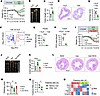 Figure 1
Vancomycin promotes colitis remission by eliminating DCA. (A–E) WT mice received 5 days of H2O or vancomycin by gavage after 5 days of 5% DSS. (A, top) Experimental outline. (A, bottom) Weight course. (B) Representative image of colon. (C) Statistical data of colon length. (D) H&E-stained histological sections. Scale bar: 500 μm. (E) Histopathology scores. n = 6 mice per group; experiment repeated 3 times. (F) Metabolite profiles in vancomycin-treated compared with H2O-treated mice. (G) DCA in feces. (H) Colon tissue after vancomycin gavage. n = 6 mice per group; experiment repeated 3 times. (I–M) WT mice received 5 days of H2O or vancomycin after 5 days of 2.5% DSS. One group of vancomycin-treated mice was simultaneously fed 2% DCA diet on days 5 to 10. (I, top) Experimental outline. (I, bottom) Weight course. Green asterisk: comparison between NCD and Van groups; red asterisk: comparison between Van and Van+DCA groups. (J) Representative image of colon. (K) Statistical data of colon length. (L) H&E-stained histological sections. Scale bar: 500 μm. (M) Histopathology scores. n = 6 mice per group; experiment repeated 3 times. (N) Within-patient comparison of Truelove-Witts scores before and after vancomycin therapy. n = 4 patients per group. (O) Heatmap represents fecal bile acid (BA) profiling and concentration of 6 BAs of patients receiving vancomycin therapy. n = 4 patients per group. Data shown as mean ± SD (A–O). Two-sided unpaired t test or 2-sided Mann-Whitney U test used in A, C, E, G, and H, depending on data normality. One-way ANOVA with Tukey’s multiple-comparison test or Kruskal-Wallis test with Dunn’s multiple-comparison test used in I, K, and M, based on data normality. Two-sided paired t test according to normal distribution in N and O. Statistical methods and exact P values are in Supporting Data Values file. *P < 0.05, **P < 0.01, ***P < 0.001, ****P < 0.0001.
To assess the role of DCA in vancomycin-relieved colitis, we administered a DCA-supplemented diet to vancomycin-treated mice during the recovery phase (Figure 1I). DCA supplementation abolished the promotion of colitis remission by vancomycin, as shown by severe weight loss, shorter colon length, and higher histology scores (Figure 1, I–M). These results indicate that DCA impedes tissue repair, and its elimination by vancomycin ameliorates colitis during the recovery phase.
Clinical evidence demonstrated that vancomycin therapy alleviated colitis in patients with UC (Figure 1N). Mass spectrometry analysis confirmed a significant reduction in fecal DCA levels after vancomycin therapy (Figure 1O). Collectively, the correlation between DCA abundance and vancomycin efficacy in both murine models and humans underscores that the therapeutic effect of vancomycin stems from depletion of DCA.
DCA impairs colitis remission by inhibiting colonic ILC2 function. Our previous studies identified that colitis-associated TNF upregulation impairs the bile acid tolerance of intestinal epithelial cells to exacerbate colitis (19). Thus, alleviation of colitis by vancomycin might arise from its impact on bile acid metabolism (18, 20). To this end, we measured the levels of colonic bile acids after vancomycin treatment and observed unaltered colonic bile acids during the recovery phase of DSS-induced colitis (Supplemental Figure 2A).
To dissect the cell compartments involved in vancomycin’s relief of colitis, we studied Rag2−/− mice lacking T and B cells and Rag2−/−Il2rg−/− mice lacking T and B cells as well as ILCs (21, 22). Compared with vehicle-treated Rag2−/− mice, vancomycin promoted colitis recovery, as evidenced by improved weight gain, longer colon length, and reduced histopathological scores (Figure 2, A–E). However, vancomycin lost the ability to promote colitis remission in Rag2−/−Il2rg−/− mice (Figure 2, F–J), suggesting the involvement of ILCs in this process. Given that ILC2s promote epithelial repair and barrier integrity through Areg production (13), we explored whether vancomycin enhances colitis recovery via ILC2s. Flow cytometry revealed that vancomycin treatment increased Areg, IL-5, and IL-13 production in colonic ILC2s of mice with DSS-induced colitis (Supplemental Figure 2, B and C), and DCA supplementation impaired this upregulation (Figure 2K and Supplemental Figure 2D). Consistently, cytometric bead array analysis of colonic tissue lysates showed a reduction in these cytokines after DCA supplementation (Supplemental Figure 2E). To further demonstrate whether vancomycin exerts its therapeutic effect through ILC2s during the recovery phase of colitis, we adoptively transferred colonic ILC2s isolated from WT mice into Rag2–/–Il2rg–/– mice and provided vancomycin-treated mice with a DCA-supplemented diet during the recovery phase (Figure 2L). Compared with vehicle-treated controls, vancomycin-treated mice that received WT-ILC2s showed accelerated weight regain, increased intestinal length, and reduced pathological scores (Figure 2, M–Q). In contrast, DCA supplementation abolished the beneficial effect of vancomycin on colitis remission (Figure 2, M–Q). Collectively, these findings highlight the essential role of ILC2s in mediating the ameliorating effects of vancomycin during colitis recovery.
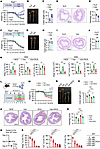 Figure 2
DCA impairs colitis remission by inhibiting colonic ILC2 function. (A–E) Rag2−/− mice received by gavage 5-day H2O or vancomycin after 5 days of 2.5% DSS. (A) Experimental outline and weight course. (B) Representative images and (C) colon lengths. (D) H&E-stained sections. Scale bar: 500 μm. (E) Histopathology scores. n = 6 mice per group; experiment repeated 3 times. (F–J) Rag2−/−Il2rg−/− mice received by gavage 5-day H2O or vancomycin after 5 days of 2.5% DSS. (F) Experimental outline and weight course. (G) Representative images and (H) colon lengths. (I) H&E-stained sections. Scale bar: 500 μm. (J) Histopathology scores. n = 6 mice per group; experiment repeated 3 times. (K) WT mice received by gavage 5-day H2O or vancomycin after 5 days of 2.5% DSS. One group of vancomycin-treated mice were simultaneously fed 2% DCA diet on days 5–10. (left) Percentages and (right) numbers of Areg+ ILC2s, IL-5+ ILC2s, and IL-13+ ILC2s in large intestine. n = 6 mice per group; experiment repeated 3 times. (L–Q) WT LI ILC2s were transferred into Rag2–/–Il2rg–/– mice during colitis recovery. Mice received 2.5% DSS for 5 days, followed by 5-day period of either vancomycin or DCA supplementation. (L) Experimental outline. (M) Weight course. Green asterisk: NCD vs. Van; red asterisk: NCD vs. DCA; blue asterisk: Van vs. Van+DCA; orange asterisk: DCA vs. Van+DCA; purple asterisk: Van vs. DCA. (N) Representative images and (O) colon lengths. (P) H&E-stained sections. Scale bar: 500 μm. (Q) Histopathology scores. n = 5 mice per group; experiment repeated twice. (R and S) Cultured ILC2s were treated with DCA for 24 hours. (R) Experimental strategy. (S) Percentages of Areg+, IL-5+, and IL-13+ ILC2s. n = 6 wells per group; experiment repeated 3 times. Data shown as mean ± SD; 2-sided unpaired t test or 2-sided Mann-Whitney U test used in A, C, E, F, H, and J, depending on data normality. One-way ANOVA with Tukey’s multiple-comparison test or Kruskal-Wallis test with Dunn’s multiple-comparison test used in K, M, O, Q, and S, based on data normality. *P < 0.05, **P < 0.01, ***P < 0.001, ****P < 0.0001.
To further explore vancomycin’s role in ILC2 function, we treated sorted colonic ILC2s with vancomycin in vitro and found no direct effect on their function (Supplemental Figure 2, F and G), suggesting that vancomycin promotes ILC2s indirectly. In contrast, DCA reduced the production of effector molecules in ILC2s in vitro (Figure 2, R and S, Supplemental Figure 3A) and in vivo (Supplemental Figure 3, B and C). Accordingly, DCA inhibited ILC2 function under both physiological and colitis recovery conditions. These findings indicate that vancomycin promotes colitis recovery by enhancing ILC2 function, which is compromised by DCA.
DCA suppresses colonic ILC2 function via a receptor-independent manner. DCA usually functions as a ligand through activating its receptors, such as TGR5 and FXR (23). To determine whether these receptors mediate DCA’s effects on ILC2s, we treated Gpbar1−/− (TGR5-KO) and Nr1h4−/− (FXR-KO) mice with DCA. Despite the absence of these receptors, DCA still impaired colonic ILC2 function in both strains (Figure 3, A and B). Additionally, when sorted ILC2s from these mice were treated with DCA in vitro, Areg, IL-5, and IL-13 production were reduced (Figure 3, C–F), confirming that DCA’s inhibitory effects on ILC2s are independent of TGR5 and FXR. To further assess whether TGR5 and FXR signaling exert cell-intrinsic effects in ILC2s, we generated mixed bone marrow chimeras in Rag2–/–Il2rg–/– mice using WT (CD45.1) together with either Gpbar1−/− (CD45.2) or Nr1h4−/− (CD45.2) bone marrow cells. After 4 weeks of reconstitution, mice received a 2-week DCA treatment (Supplemental Figure 4A). Subsequent analysis showed that colonic ILC2s and ILC2s derived from WT donors producing Areg, IL-5, and IL-13 were comparable to ILC2s originating from either Gpbar1−/− or Nr1h4−/− bone marrow (Supplemental Figure 4, B–E).
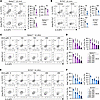 Figure 3
DCA suppresses colonic ILC2 function via a receptor-independent manner. (A) Gpbar1–/– mice were i.p. injected with DCA or DMSO for 14 days. (A, left) Representative flow cytometry plots. (A, right) Percentages of Areg+, IL-5+, and IL-13+ ILC2s (CD45.2+Lin–GATA3+) in large intestine. n = 5 mice per group. The experiment was repeated twice. (B) Nr1h4−/− mice were i.p. injected with DCA or DMSO for 14 days. (B, left) Representative flow cytometry plots. (B, right) Percentages of Areg+, IL-5+, and IL-13+ ILC2s (CD45.2+Lin–GATA3+) in large intestine. n = 5 mice per group. The experiment was repeated twice. (C and D) Large intestinal ILC2s were sorted from Gpbar1–/– mice and cultured in the presence of IL-2, IL-7, IL-25, and IL-33 for 5 days. ILC2s were treated with DCA at the indicated concentrations for 24 hours. (C) Representative flow cytometry plots. (D) Percentages of Areg+, IL-5+, and IL-13+ ILC2s (CD45.2+Lin–GATA3+). n = 6 wells per group. The experiment was repeated 3 times. (E and F) Large intestinal ILC2s were sorted from Nr1h4−/− mice and cultured in the presence of IL-2, IL-7, IL-25, and IL-33 for 5 days. ILC2s were treated with DCA at the indicated concentrations for 24 hours. (E) Representative flow cytometry plots. (F) Percentages of Areg+, IL-5+, and IL-13+ ILC2s (CD45.2+Lin–GATA3+). n = 6 wells per group. The experiment was repeated 3 times. Data are shown as mean ± SD; 2-sided unpaired t test or 2-sided Mann-Whitney U test was used in A and B, depending on data normality. One-way ANOVA with Tukey’s multiple-comparison test or Kruskal-Wallis test with Dunn’s multiple-comparison test was used in D and F, based on data normality. Statistical methods and exact P values are provided in the Supporting Data Values file. **P < 0.01, ***P < 0.001, ****P < 0.0001.
We further evaluated whether DCA-induced inhibition of ILC2 function was due to cell death, given bile acids’ detergent properties. DCA reduced the production of effector molecules by ILC2, but it did not affect cell viability (Supplemental Figure 4F). In contrast, SDS, which has similar cytotoxicity to DCA (24), did not reduce cytokine production in ILC2s to the same extent (Supplemental Figure 4, G and H). These results suggest that DCA inhibits ILC2 function without inducing cell death via its detergent-like activity.
DCA disrupts protein folding in ILC2s by binding to TMX2 in the ER. To understand how DCA inhibits ILC2 function, we performed RNA-Seq on sorted ILC2s treated with DCA in vitro. DCA did not alter the transcription of characteristic ILC2 genes, including Il5, Il13, and Areg (Figure 4, A–C). In addition, sorted ILC2s from Il5RFP-Cre mice treated with DCA showed that the RFP signals in ILC2s, which reflected the transcription of Il5, were not altered by DCA (Figure 4, D–F). These findings suggest the inhibition of DCA on ILC2s occurs posttranscriptionally. Further analysis using an in vitro protein synthesis system revealed that DCA had no impact on the translation of Areg, Il5, and Il13, the effector molecules of ILC2s (Figure 4, G and H). However, cytometric bead array analysis revealed that DCA treatment significantly reduced the protein levels of these cytokines in ILC2s (Figure 4I), indicating that DCA inhibited the protein processing of these secretory proteins posttranslationally.
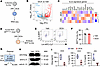 Figure 4
Inhibition of DCA on ILC2 function does not occur at transcription or translation. (A–C) Large intestinal ILC2s were sorted from WT mice and cultured in the presence of IL-2, IL-7, IL-25, and IL-33 for 5 days. ILC2s were treated with DCA (100 μM) at the indicated concentrations for 24 hours and then subjected to RNA-Seq. (A) Experimental strategy, (B) volcano plot, and (C) heatmap of ILC2-characteristic genes. (D–F) Sorted large intestinal ILC2s from Il5RFP-Cre mice were treated with DCA (100 μM) for 24 hours. (D) Experimental strategy. (E) Representative flow cytometry plots. (F) Percentages of RFP+ ILC2s (CD45.2+Lin–GATA3+) in large intestine. n = 6 wells per group. The experiment was repeated 3 times. (G–I) Rabbit reticulocyte lysate system. (G) Experimental strategy. Protein levels of Areg, IL-5, and IL-13 were analyzed by (H) Western blotting and (I) cytometric bead array in samples treated or untreated with DCA. n = 6 wells per group. The experiment was repeated twice. Data are shown as mean ± SD. Statistical analysis was performed using unpaired 2-tailed t test. ***P < 0.001, ****P < 0.0001.
The secretory proteins acquired specific 3D structures in the ER to become functional and were then secreted out of the cells. In accordance, our confocal imaging analysis revealed that DCA localized to the ER in ILC2s, revealed by colocalization of DCA-iF647 and ER-Tracker (Figure 5A). Furthermore, the use of fluorescent dye–based reagent Proteostat, which exhibits red fluorescent signals binding to misfolded proteins, showed a remarkable increase of protein misfolding in ILC2s treated with DCA (Figure 5, B and C). To uncover how DCA affects protein processing in the ER, a pulldown assay using biotin-labeled DCA identified 614 DCA-interacting proteins, of which TMX2, a protein with disulfide reductase activity in the ER, was of particular interest (Figure 5, D and E, and Supplemental Table 4). The TMX protein family consists of TMX1, TMX2, TMX3, and TMX4, with TMX2 exhibiting the highest level of expression in ILC2s (Figure 5F). The interaction between DCA and TMX2 was corroborated by immunoblotting in a DCA pulldown assay with ILC2 lysates (Figure 5E), and molecular docking analysis showed a high binding affinity, with a binding energy of –6.7 kcal/mol (Figure 5, G and H). Surface plasmon resonance assay further supported that DCA directly binds to TMX2 with a dissociation constant, Kd, at 1.365 μM (Figure 5, I and J).
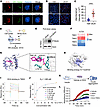 Figure 5
DCA disrupts protein folding in ILC2s by binding to TMX2 in the ER. (A) ILC2s were treated with DCA-iF647 (1 μM, red) for 15 minutes, followed by staining with ER-Tracker (green) or Mito-Tracker (green), and Hoechst 33342 (blue). Representative confocal laser scanning microscopy (LSCM) images. (B and C) Protein misfolding was quantified using the molecular rotor Proteostat with affinity for aggregated proteins. Increased protein aggregation causes the dye to stop spinning and emit fluorescence. We analyzed misfolding in ILC2s treated with DCA (100 μM) for 24 hours. (B) Representative confocal LSCM images. (C) Relative mean intensity per cell was plotted and calculated after blinding. n = 36 for DMSO-treated ILC2s, n = 34 for ILC2s treated with 100 μM DCA. The experiment was repeated 3 times. (D) Schematic of DCA-protein pulldown assays in cell lysates in combination with mass spectrometry analysis. (E) Representative immunoblot of TMX2 in proteins pulled down from ILC2 lysates by biotin-DCA (100 μM). (F) Heatmap of TMX family genes by performing RNA-Seq analysis with purified ILC2s. (G and H) Molecular docking showing the binding of DCA to TMX2. (I and J) Surface plasmon resonance assay for the affinity between different concentrations of DCA and purified TMX2 protein. RU, resonance unit. (K and L) Reductase activity of TMX2. (K) Experimental strategy. (L) Purified TMX2 protein with or without DCA (200 μM) was incubated with insulin, and the ability to reduce insulin disulfide bonds was measured. The absorbance at 595 nm was monitored every 2.5 minutes. n = 3 wells per group. Data shown as mean ± SD. Statistical analysis was performed using unpaired 2-tailed t test. ****P < 0.0001.
To further confirm that DCA impaired protein processing, commonly as protein misfolding, by interacting with TMX2, an insulin disulfide reducing assay was performed to analyze the disulfide reductase activity of TMX2 in the presence of DCA (Figure 5K). The results showed that TMX2 acted as a disulfide reductase, which was inhibited by DCA (Figure 5L).
The PERK/eIF2α branch of UPR mediates the inhibitory effects of DCA on ILC2 function and colitis recovery. The accumulation of misfolded proteins in the ER triggers the UPR (25), which activates 3 pathways, IRE1α/Xbp1, PERK/eIF2α, and ATF6 (Figure 6A). We observed that DCA treatment increased the levels of spliced Xbp1, phosphorylated PERK and eIF2α, and ATF6 in ILC2s (Figure 6, B and C). Similarly, treatment with tunicamycin, an ER stress inducer, impaired ILC2 function, further highlighting the detrimental effect of ER stress on gut ILC2s (Figure 6D and Supplemental Figure 5A). To identify the specific UPR pathway responsible for DCA-induced ILC2 dysfunction, we treated sorted ILC2s with DCA in combination with inhibitors targeting each UPR branch. Only inhibition of PERK phosphorylation by GSK2606414 restored ILC2 function (Figure 6, E–G, and Supplemental Figure 5, B–D). Consistently, CCT020312, a PERK phosphorylation agonist, suppressed effector molecule production by ILC2s (Figure 6H and Supplemental Figure 5E).
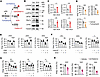 Figure 6
DCA enhances UPR in ILC2s. Large intestinal ILC2s were sorted from WT mice and cultured in the presence of IL-2, IL-7, IL-25, and IL-33 for 5 days. (A) Schematic representation of the ER stress signaling pathways. (B and C) ILC2s were treated with 100 μM DCA for 24 hours. (B) Immunoblotting of p-PERK, PERK, p-eIF2α, eIF2α, Xbp1s, ATF6. (C) Expression levels of p-PERK/PERK, p-eIF2α/eIF2α, Xbp1s, and ATF6 in ILC2s. p-PERK, phospho-PERK; eIF2α, eukaryotic initiation factor-2α; p-eIF2α, phospho-eIF2α; Xbp1s, spliced X-box binding protein-1; ATF6, activating transcription factor 6. (D) ILC2s were treated with ER stress activator (tunicamycin, 0.3 μM) for 24 hours. Percentages of Areg+, IL-5+, and IL-13+ ILC2s (CD45.2+Lin–GATA3+). n = 5 wells per group. The experiment was repeated twice. (E–G) Percentages of Areg+, IL-5+, and IL-13+ ILC2s (CD45.2+Lin–GATA3+) in groups treated with ER stress inhibitors targeting (E) PERK phosphorylation (GSK, 10 μM), (F) ATF6 (Cea-A7, 10 μM), and (G) IRE1α (4μ8c, 20 μM). ILC2s were treated with DMSO or DCA (100 μM) for 24 hours. n = 6 wells per group. The experiment was repeated 3 times. (H) Percentages of Areg+, IL-5+, and IL-13+ ILC2s (CD45.2+Lin–GATA3+) in groups treated with PERK phosphorylation activator (CCT020312, 10 μM). n = 6 wells per group. The experiment was repeated 3 times. Data shown as mean ± SD; 2-sided unpaired t test or 2-sided Mann-Whitney U test used in C, D, and H, depending on data normality. One-way ANOVA with Tukey’s multiple-comparison test or Kruskal-Wallis test with Dunn’s multiple-comparison test used in E–G, based on data normality. Statistical methods and exact P values are in the Supporting Data Values file. *P < 0.05, **P < 0.01, ***P < 0.001, ****P < 0.0001.
To explore the therapeutic potential of targeting the PERK/eIF2α axis of UPR, DCA-treated mice were administered GSK2606414 during the recovery phase of DSS-induced colitis. Inhibition of PERK phosphorylation facilitated colitis remission, as evidenced by improved weight gain, colon length, and histological scores (Figure 7, A–E). Flow cytometry revealed enhanced production of Areg, IL-5, and IL-13 in colonic ILC2s, suggesting that PERK activation impedes tissue repair during colitis recovery (Figure 7, F and G). In accordance, DCA treatment of human lamina propria mononuclear cells significantly reduced AREG expression in human colonic ILC2s, and this inhibition was restored by GSK2606414 (Figure 7, H and I). Moreover, ISRIB, a PERK/eIF2α inhibitor that restores eIF2α phosphorylation, also rescued DCA-inhibited ILC2 function and promoted tissue repair (Supplemental Figure 6, A–J). These findings indicate that the PERK/eIF2α arm of the UPR mediates the inhibitory effect of DCA on ILC2s and impedes colitis recovery.
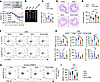 Figure 7
The PERK branch of UPR mediates DCA-inhibited ILC2 function and colitis recovery. (A–G) WT mice received NCD or DCA by gavage for 5 days, starting 5 days after 2.5% DSS administration. One group of NCD- or DCA-fed mice was simultaneously i.p. injected with GSK2606414 or vehicle for 5 days. (A, top) Experimental outline is shown. (A, bottom) Weight course. The red asterisk represents comparison between NCD and DCA groups; green asterisk represents comparison between DCA and DCA+GSK groups; purple asterisk represents comparison between Van and DCA groups. (B) Representative image of colon. (C) Statistical data of colon length. (D) H&E-stained histological sections. Scale bar: 500 μm. (E) Histopathology scores. (F) Representative flow cytometry plots. (G, top) Percentages of Areg+, IL-5+, and IL-13+ ILC2s (CD45.2+Lin–GATA3+) and (G, bottom) absolute numbers of Areg+ ILC2s, IL-5+ ILC2s, and IL-13+ ILC2s in large intestine. n = 5 mice per group. The experiment was repeated twice. (H and I) Human colonic lamina propria mononuclear cells were stimulated with DCA at 100 μM, supplemented with or without GSK2606414 for 16 hours in complete RPMI 1640 media. (H) AREG expression was analyzed after gating on CD45+Lin−CD127+CRTH2+ ILC2s. (I) Percentage of AREG+ ILC2s. Connected lines are samples from the same clinical samples (n = 10). Data are shown as mean ± SD. One-way ANOVA with Tukey’s multiple-comparison test or Kruskal-Wallis test with Dunn’s multiple-comparison test used in A, C, E, G, and I, based on data normality. Statistical methods and exact P values are provided in the Supporting Data Values file.*P < 0.05, **P < 0.01, ***P < 0.001, ****P < 0.0001.


