
Clinical Research and Public HealthImmunologyInfectious disease
Open Access |  10.1172/jci.insight.199941
Th2 skewing in patients with disseminated coccidioidomycosis
Timothy J. Thauland,1 Smriti S. Nagarajan,1 Alexis V. Stephens,2 Samantha L. Jensen,2 Anviksha Srivastava,1 Miguel A. Moreno Lastre,1 Terrie S. Ahn,1 Chantana Bun,1 Michael T. Trump,1 Royce H. Johnson,3,4,5 George R. Thompson III,6,7 Maria I. Garcia-Lloret,1 Valerie A. Arboleda,2 and Manish J. Butte1,2,8
1Department of Pediatrics, Division of Immunology, Allergy, and Rheumatology, and
2Department of Human Genetics, UCLA, Los Angeles, California, USA.
3Department of Medicine, Division of Infectious Diseases, Kern Medical Center, Bakersfield, California, USA.
4Department of Medicine, Division of Infectious Diseases, UCLA, Los Angeles, California, USA.
5Valley Fever Institute at Kern Medical, Bakersfield, California, USA.
6Department of Medicine, Division of Infectious Diseases, and
7Department of Medical Microbiology and Immunology, University of California, Davis, Sacramento, California, USA.
8Department of Microbiology, Immunology, and Molecular Genetics, UCLA, Los Angeles, California, USA.
Address correspondence to: Manish J. Butte, 10833 Le Conte Ave, MDCC Building, Room 12-430, Los Angeles, California, 90095, USA. Email: mbutte@mednet.ucla.edu.
Find articles by Thauland, T. in: PubMed | Google Scholar
1Department of Pediatrics, Division of Immunology, Allergy, and Rheumatology, and
2Department of Human Genetics, UCLA, Los Angeles, California, USA.
3Department of Medicine, Division of Infectious Diseases, Kern Medical Center, Bakersfield, California, USA.
4Department of Medicine, Division of Infectious Diseases, UCLA, Los Angeles, California, USA.
5Valley Fever Institute at Kern Medical, Bakersfield, California, USA.
6Department of Medicine, Division of Infectious Diseases, and
7Department of Medical Microbiology and Immunology, University of California, Davis, Sacramento, California, USA.
8Department of Microbiology, Immunology, and Molecular Genetics, UCLA, Los Angeles, California, USA.
Address correspondence to: Manish J. Butte, 10833 Le Conte Ave, MDCC Building, Room 12-430, Los Angeles, California, 90095, USA. Email: mbutte@mednet.ucla.edu.
Find articles by Nagarajan, S. in: PubMed | Google Scholar
1Department of Pediatrics, Division of Immunology, Allergy, and Rheumatology, and
2Department of Human Genetics, UCLA, Los Angeles, California, USA.
3Department of Medicine, Division of Infectious Diseases, Kern Medical Center, Bakersfield, California, USA.
4Department of Medicine, Division of Infectious Diseases, UCLA, Los Angeles, California, USA.
5Valley Fever Institute at Kern Medical, Bakersfield, California, USA.
6Department of Medicine, Division of Infectious Diseases, and
7Department of Medical Microbiology and Immunology, University of California, Davis, Sacramento, California, USA.
8Department of Microbiology, Immunology, and Molecular Genetics, UCLA, Los Angeles, California, USA.
Address correspondence to: Manish J. Butte, 10833 Le Conte Ave, MDCC Building, Room 12-430, Los Angeles, California, 90095, USA. Email: mbutte@mednet.ucla.edu.
Find articles by Stephens, A. in: PubMed | Google Scholar
1Department of Pediatrics, Division of Immunology, Allergy, and Rheumatology, and
2Department of Human Genetics, UCLA, Los Angeles, California, USA.
3Department of Medicine, Division of Infectious Diseases, Kern Medical Center, Bakersfield, California, USA.
4Department of Medicine, Division of Infectious Diseases, UCLA, Los Angeles, California, USA.
5Valley Fever Institute at Kern Medical, Bakersfield, California, USA.
6Department of Medicine, Division of Infectious Diseases, and
7Department of Medical Microbiology and Immunology, University of California, Davis, Sacramento, California, USA.
8Department of Microbiology, Immunology, and Molecular Genetics, UCLA, Los Angeles, California, USA.
Address correspondence to: Manish J. Butte, 10833 Le Conte Ave, MDCC Building, Room 12-430, Los Angeles, California, 90095, USA. Email: mbutte@mednet.ucla.edu.
Find articles by Jensen, S. in: PubMed | Google Scholar
1Department of Pediatrics, Division of Immunology, Allergy, and Rheumatology, and
2Department of Human Genetics, UCLA, Los Angeles, California, USA.
3Department of Medicine, Division of Infectious Diseases, Kern Medical Center, Bakersfield, California, USA.
4Department of Medicine, Division of Infectious Diseases, UCLA, Los Angeles, California, USA.
5Valley Fever Institute at Kern Medical, Bakersfield, California, USA.
6Department of Medicine, Division of Infectious Diseases, and
7Department of Medical Microbiology and Immunology, University of California, Davis, Sacramento, California, USA.
8Department of Microbiology, Immunology, and Molecular Genetics, UCLA, Los Angeles, California, USA.
Address correspondence to: Manish J. Butte, 10833 Le Conte Ave, MDCC Building, Room 12-430, Los Angeles, California, 90095, USA. Email: mbutte@mednet.ucla.edu.
Find articles by Srivastava, A. in: PubMed | Google Scholar
1Department of Pediatrics, Division of Immunology, Allergy, and Rheumatology, and
2Department of Human Genetics, UCLA, Los Angeles, California, USA.
3Department of Medicine, Division of Infectious Diseases, Kern Medical Center, Bakersfield, California, USA.
4Department of Medicine, Division of Infectious Diseases, UCLA, Los Angeles, California, USA.
5Valley Fever Institute at Kern Medical, Bakersfield, California, USA.
6Department of Medicine, Division of Infectious Diseases, and
7Department of Medical Microbiology and Immunology, University of California, Davis, Sacramento, California, USA.
8Department of Microbiology, Immunology, and Molecular Genetics, UCLA, Los Angeles, California, USA.
Address correspondence to: Manish J. Butte, 10833 Le Conte Ave, MDCC Building, Room 12-430, Los Angeles, California, 90095, USA. Email: mbutte@mednet.ucla.edu.
Find articles by Moreno Lastre, M. in: PubMed | Google Scholar
1Department of Pediatrics, Division of Immunology, Allergy, and Rheumatology, and
2Department of Human Genetics, UCLA, Los Angeles, California, USA.
3Department of Medicine, Division of Infectious Diseases, Kern Medical Center, Bakersfield, California, USA.
4Department of Medicine, Division of Infectious Diseases, UCLA, Los Angeles, California, USA.
5Valley Fever Institute at Kern Medical, Bakersfield, California, USA.
6Department of Medicine, Division of Infectious Diseases, and
7Department of Medical Microbiology and Immunology, University of California, Davis, Sacramento, California, USA.
8Department of Microbiology, Immunology, and Molecular Genetics, UCLA, Los Angeles, California, USA.
Address correspondence to: Manish J. Butte, 10833 Le Conte Ave, MDCC Building, Room 12-430, Los Angeles, California, 90095, USA. Email: mbutte@mednet.ucla.edu.
Find articles by Ahn, T. in: PubMed | Google Scholar
1Department of Pediatrics, Division of Immunology, Allergy, and Rheumatology, and
2Department of Human Genetics, UCLA, Los Angeles, California, USA.
3Department of Medicine, Division of Infectious Diseases, Kern Medical Center, Bakersfield, California, USA.
4Department of Medicine, Division of Infectious Diseases, UCLA, Los Angeles, California, USA.
5Valley Fever Institute at Kern Medical, Bakersfield, California, USA.
6Department of Medicine, Division of Infectious Diseases, and
7Department of Medical Microbiology and Immunology, University of California, Davis, Sacramento, California, USA.
8Department of Microbiology, Immunology, and Molecular Genetics, UCLA, Los Angeles, California, USA.
Address correspondence to: Manish J. Butte, 10833 Le Conte Ave, MDCC Building, Room 12-430, Los Angeles, California, 90095, USA. Email: mbutte@mednet.ucla.edu.
Find articles by Bun, C. in: PubMed | Google Scholar
1Department of Pediatrics, Division of Immunology, Allergy, and Rheumatology, and
2Department of Human Genetics, UCLA, Los Angeles, California, USA.
3Department of Medicine, Division of Infectious Diseases, Kern Medical Center, Bakersfield, California, USA.
4Department of Medicine, Division of Infectious Diseases, UCLA, Los Angeles, California, USA.
5Valley Fever Institute at Kern Medical, Bakersfield, California, USA.
6Department of Medicine, Division of Infectious Diseases, and
7Department of Medical Microbiology and Immunology, University of California, Davis, Sacramento, California, USA.
8Department of Microbiology, Immunology, and Molecular Genetics, UCLA, Los Angeles, California, USA.
Address correspondence to: Manish J. Butte, 10833 Le Conte Ave, MDCC Building, Room 12-430, Los Angeles, California, 90095, USA. Email: mbutte@mednet.ucla.edu.
Find articles by Trump, M. in: PubMed | Google Scholar
1Department of Pediatrics, Division of Immunology, Allergy, and Rheumatology, and
2Department of Human Genetics, UCLA, Los Angeles, California, USA.
3Department of Medicine, Division of Infectious Diseases, Kern Medical Center, Bakersfield, California, USA.
4Department of Medicine, Division of Infectious Diseases, UCLA, Los Angeles, California, USA.
5Valley Fever Institute at Kern Medical, Bakersfield, California, USA.
6Department of Medicine, Division of Infectious Diseases, and
7Department of Medical Microbiology and Immunology, University of California, Davis, Sacramento, California, USA.
8Department of Microbiology, Immunology, and Molecular Genetics, UCLA, Los Angeles, California, USA.
Address correspondence to: Manish J. Butte, 10833 Le Conte Ave, MDCC Building, Room 12-430, Los Angeles, California, 90095, USA. Email: mbutte@mednet.ucla.edu.
Find articles by Johnson, R. in: PubMed | Google Scholar
1Department of Pediatrics, Division of Immunology, Allergy, and Rheumatology, and
2Department of Human Genetics, UCLA, Los Angeles, California, USA.
3Department of Medicine, Division of Infectious Diseases, Kern Medical Center, Bakersfield, California, USA.
4Department of Medicine, Division of Infectious Diseases, UCLA, Los Angeles, California, USA.
5Valley Fever Institute at Kern Medical, Bakersfield, California, USA.
6Department of Medicine, Division of Infectious Diseases, and
7Department of Medical Microbiology and Immunology, University of California, Davis, Sacramento, California, USA.
8Department of Microbiology, Immunology, and Molecular Genetics, UCLA, Los Angeles, California, USA.
Address correspondence to: Manish J. Butte, 10833 Le Conte Ave, MDCC Building, Room 12-430, Los Angeles, California, 90095, USA. Email: mbutte@mednet.ucla.edu.
Find articles by
Thompson, G.
in:
PubMed
|
Google Scholar
|

1Department of Pediatrics, Division of Immunology, Allergy, and Rheumatology, and
2Department of Human Genetics, UCLA, Los Angeles, California, USA.
3Department of Medicine, Division of Infectious Diseases, Kern Medical Center, Bakersfield, California, USA.
4Department of Medicine, Division of Infectious Diseases, UCLA, Los Angeles, California, USA.
5Valley Fever Institute at Kern Medical, Bakersfield, California, USA.
6Department of Medicine, Division of Infectious Diseases, and
7Department of Medical Microbiology and Immunology, University of California, Davis, Sacramento, California, USA.
8Department of Microbiology, Immunology, and Molecular Genetics, UCLA, Los Angeles, California, USA.
Address correspondence to: Manish J. Butte, 10833 Le Conte Ave, MDCC Building, Room 12-430, Los Angeles, California, 90095, USA. Email: mbutte@mednet.ucla.edu.
Find articles by Garcia-Lloret, M. in: PubMed | Google Scholar
1Department of Pediatrics, Division of Immunology, Allergy, and Rheumatology, and
2Department of Human Genetics, UCLA, Los Angeles, California, USA.
3Department of Medicine, Division of Infectious Diseases, Kern Medical Center, Bakersfield, California, USA.
4Department of Medicine, Division of Infectious Diseases, UCLA, Los Angeles, California, USA.
5Valley Fever Institute at Kern Medical, Bakersfield, California, USA.
6Department of Medicine, Division of Infectious Diseases, and
7Department of Medical Microbiology and Immunology, University of California, Davis, Sacramento, California, USA.
8Department of Microbiology, Immunology, and Molecular Genetics, UCLA, Los Angeles, California, USA.
Address correspondence to: Manish J. Butte, 10833 Le Conte Ave, MDCC Building, Room 12-430, Los Angeles, California, 90095, USA. Email: mbutte@mednet.ucla.edu.
Find articles by
Arboleda, V.
in:
PubMed
|
Google Scholar
|
1Department of Pediatrics, Division of Immunology, Allergy, and Rheumatology, and
2Department of Human Genetics, UCLA, Los Angeles, California, USA.
3Department of Medicine, Division of Infectious Diseases, Kern Medical Center, Bakersfield, California, USA.
4Department of Medicine, Division of Infectious Diseases, UCLA, Los Angeles, California, USA.
5Valley Fever Institute at Kern Medical, Bakersfield, California, USA.
6Department of Medicine, Division of Infectious Diseases, and
7Department of Medical Microbiology and Immunology, University of California, Davis, Sacramento, California, USA.
8Department of Microbiology, Immunology, and Molecular Genetics, UCLA, Los Angeles, California, USA.
Address correspondence to: Manish J. Butte, 10833 Le Conte Ave, MDCC Building, Room 12-430, Los Angeles, California, 90095, USA. Email: mbutte@mednet.ucla.edu.
Find articles by
Butte, M.
in:
PubMed
|
Google Scholar
|
Published April 21, 2026 - More info
JCI Insight. 2026;11(10):e199941. https://doi.org/10.1172/jci.insight.199941.
© 2026 Thauland et al. This work is licensed under the Creative Commons Attribution 4.0 International License. To view a copy of this license, visit http://creativecommons.org/licenses/by/4.0/.
Received: September 5, 2025; Accepted: March 31, 2026

-
Results
Our patient cohort was drawn from the San Joaquin Valley of California and surrounding counties. They were recruited either at the Valley Fever Institute in Bakersfield or the Center for Valley Fever at the University of California, Davis. Our patient cohort was divided into the following clinical categories that we have previously described: 2, uncomplicated coccidioidomycosis; 3, complicated pulmonary disease (including patients with fibro-cavitary disease, persistent disease despite 6 months of treatment, and respiratory failure); 4, disseminated disease without meningitis; and 5, disseminated disease with meningitis (30). The relevant characteristics of our patient cohort are shown in Table 1. Of note, approximately two-thirds of individuals with complicated pulmonary and disseminated disease were male, and over half of our cohort self-identified as Hispanic or Latino. These demographics are in line with previous population-based studies on coccidioidomycosis disease burden in the central valley of California (31). The design of our study is shown in Figure 1.
To measure cytokine production, we purified CD4+ T cells from both patients and healthy controls, activated them polyclonally, and performed intracellular cytokine staining (ICCS) on acutely restimulated cells. The proportions of Th1 cells (defined as IFN-γ+IL-4–) and Th2 cells (defined as IFN-γ–IL-4+) were determined (Figure 2A) and the Th2/Th1 ratio was calculated. Most controls and coccidioidomycosis patients had Th2/Th1 ratios less than 1, but among patients there was a marked tail of individuals with high Th2/Th1 ratios (Figure 2B and Supplemental Figure 1A; supplemental material available online with this article; https://doi.org/10.1172/jci.insight.199941DS1). To identify Th2-skewed patients, we calculated an optimal threshold (maximizing sensitivity and specificity) for the Th2/Th1 ratio using receiver operating characteristic (ROC) curves comparing pulmonary-only and disseminated patients (Th2/Th1 ratio ~1.27). We used the same ROC curves to set a second threshold at 95% specificity (Th2/Th1 ratio ~1.57). The proportion of coccidioidomycosis patients with a Th2/Th1 ratio greater than the optimal threshold increased with increasing disease severity, with significantly more DCM patients with a Th2-skewed phenotype than controls (OR 3.3, 95% CI [1.2, 12.8]; OR 8.1, 95% CI [1.0, 292.2] for 95% specificity threshold) or patients with pulmonary-only disease (OR 2.4, 95% CI [1.2, 5.5]; OR 2.9, 95% CI [1.2, 9.2] at 95% specificity) (Figure 2B). Together, these results reveal that a substantial fraction (23%) of patients with severe coccidioidomycosis showed Th2 skewing.
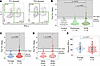 Figure 2
Th2 skewing of CD4+ T cells in coccidioidomycosis. (A) ICCS data for expression of IFN-γ and IL-4 was used to generate Th2/Th1 ratios. An example of a Th1- and Th2-skewed patient is shown. (B) Th2 skewing in controls and patients with pulmonary disease or DCM. Th2 skewing is significantly more common in patients with DCM (Fisher’s exact test at optimal cutoff; at 95% specificity, P = 0.005 (Cont. vs. DCM) and P = 0.017 (Pulm. vs. DCM). (C) Th2/Th1 ratio stratification by sex reveals that Th2-skewed individuals with DCM are predominantly male (Fisher’s exact test at optimal cutoff; at 95% specificity, P = 0.004). (D) Among males, significantly more patients had DCM than pulmonary-only disease (Fisher’s exact test at optimal cutoff; at 95% specificity, P = 0.020). (E) Females had more IFN-γ–producing cells than males (Wilcoxon’s rank-sum test). Box-and-whisker plots show the median (thick black bar in the gray box), interquartile range (top and bottom edges of gray box), and 95% CI (the narrowed waist of the gray box around the median). Each dot is 1 participant.
There are conflicting data on whether there is an inherent difference in Th1/Th2 bias in males and females (32, 33), with some studies showing enhanced Th1 skewing in males (34) and others in females (35). Given that male sex is a known risk factor for progression to DCM (36), we stratified our patient cohort by sex and examined the Th2/Th1 ratio, using thresholds generated from ROC curves comparing these groups. We found a strong bias toward male sex in Th2-skewed patients overall (OR 2.3, 95% CI [1.3, 4.6]; OR, 95% CI 4.0 [1.5, 15.2] at 95% specificity) (Figure 2C) and within the DCM group (OR 2.8, 95% CI [1.2, 7.9]; OR 4.0, 95% CI [1.0, 31.9] at 95% specificity) (Supplemental Figure 1B). Males with DCM were significantly more likely to be Th2 skewed than males with pulmonary-only disease (OR 2.5, 95% CI [1.1, 7.0]; OR 3.6, 95% CI [1.1, 19.0] at 95% specificity) (Figure 2D), while there was no difference for females in Th2 skewing between patients with DCM or pulmonary-only disease (Supplemental Figure 1C). In accord with the results for the Th2/Th1 ratio, females on average made significantly more IFN-γ than males (Figure 2E). Together, these results demonstrated an unexpected and marked sex bias of Th2 skewing in patients with severe coccidioidomycosis.
Some studies have shown that age may affect Th1/Th2 balance, with older adults biased toward Th2 responses, although contradictory results also exist (37–39). When we stratified our patient cohort by age and examined cytokine production, there was no discernible pattern. Th2-skewed patients were found in every age cohort (Supplemental Figure 1D). These results show no relationship between Th2 skewing and age.
Patterns of chemokine receptor expression on memory CD4+ T cells have been used as surrogate markers for helper T cell polarization (40). We measured chemokine receptor expression on CD4+ memory T cells from our patient cohort to determine whether these surrogate markers could be used to discern individuals who showed Th2 skewing (Supplemental Figure 2A). We compared the percentage of CD4+CD45RO+ memory cells with a CCR6–CXCR3+CCR4– (Th1) or CCR6–CXCR3–CCR4+ (Th2) phenotype against the measured Th2/Th1 ratio of cytokine-producing cells (Supplemental Figure 2, B and C). The relationship between chemokine receptor expression and cytokine production showed the expected association (i.e., a negative slope when the percentage of cells with a Th1 chemokine receptor phenotype is plotted against Th2/Th1 ratio). However, only the correlation of Th2 memory cell levels with Th2/Th1 ratio reached statistical significance, and the contribution of percentage Th2 memory cells to the variance in Th2/Th1 ratio was modest (r2 = 0.12). These results suggest that the chemokine receptor expression on CD4+ T cells is not a good surrogate for cytokine production in these individuals.
Type-2 skewing of immune responses is found in atopic disease, in many cases characterized by eosinophilia and elevated levels of serum IgE (41). However, there were substantial numbers of atopic patients in all clinical categories (28%–41%), with no significant differences between clinical categories or between Th1-skewed (34.5%) and Th2-skewed (24.2%) patients (Table 1). We sought to determine whether patients with Th2 skewing in our coccidioidomycosis cohort had other hallmarks of severe atopic disease by comparing eosinophil counts and total serum IgE with the Th2/Th1 ratio, but no clear trends were present (Supplemental Figure 3, A and B). We note that not all patients had laboratory findings available, and only a handful of patients in our entire cohort had either eosinophilia or elevated IgE. Additionally, there was no correlation between eosinophil counts and IgE levels among patients for whom both measurements were available (Supplemental Figure 3C).
We also measured the plasma concentration of 9 cytokines associated with atopy in cohorts of Th2-skewed patients and age, sex, and disease-severity-matched Th1-skewed patients (Supplemental Figure 4A). While several atopic individuals showed high levels of the canonical Type-2 cytokines (IL-4, IL-5, IL-13, and IL-33), there was no correlation between plasma cytokine levels and Th skewing (Supplemental Figure 4B). Together, these results show that the presence of atopic disease was not predictive of Th2 skewing in our coccidioidomycosis cohort.
The production of IL-17 cytokines by Th17 cells is crucial for mucosal defenses to fungal and bacterial infections. Both vaccine studies in mice (42, 43) and ex vivo analysis of T cells from pediatric patients (44) suggest that Th17 cells offer protection from coccidioidomycosis. Crucially, there is evidence that Th17 cells are important for preventing progression to DCM (4). Thus, we examined IL-17A production by CD4+ T cells (Figure 3A). Compared with healthy controls, we found a higher frequency of IL-17A–producing cells in patients with coccidioidomycosis. However, we did not observe any differences in Th17 skewing between pulmonary-only and DCM patients (Figure 3B). The percentages of IL-17A–and IFN-γ–producing cells were correlated within our coccidioidomycosis patients (Figure 3C). These results were highlighted by the fact that high Th2/Th1 ratios and large proportions of IL-17A–producing cells were mutually exclusive in our patient cohort (Figure 3D). When patients were segregated by sex, we found a trend toward a lower frequency of IL-17A–producing cells in male patients (P = 0.058) (Figure 3E), suggesting that Th2 skewing may come at the expense of Th17 defenses in some male individuals. Taken together, these results show that while IL-17A production does not vary by disease severity, Th2-skewed patients – predominantly males – have low proportions of Th17 cells.
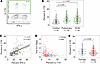 Figure 3
Analysis of Th17 polarization in patients with coccidioidomycosis. (A) Example of ICCS for measurement of Th17 polarization. (B) Coccidioidomycosis patients have significantly more Th17 cells than healthy controls, but no differences are seen when patients are stratified by disease severity (Kruskal-Wallis rank-sum test with Dunn’s post hoc test and Bonferroni’s correction). (C) Percentages of IL-17A– and IFN-γ–producing cells are correlated in coccidioidomycosis patients (Spearman’s rank correlation test). (D) Scatter plot showing an inverse correlation between percentage IL-17A–producing cells and Th2/Th1 ratio. (E) Male patients trended toward having fewer IL-17A–producing cells than females (Wilcoxon’s rank-sum test). Box plots show the median, interquartile range, and 95% CI (notch). Each dot is 1 participant.
We have previously demonstrated the efficacy of treating patients with refractory DCM and Th2 skewing with IFN-γ and dupilumab (IL-4R blockade) (27, 28). To demonstrate the efficacy of dupilumab alone in shifting the balance of cytokine production by CD4+ T cells ex vivo in patients with coccidioidomycosis, we cultured CD4+ T cells from patients in our cohort with or without dupilumab and measured cytokine production by ICCS (Figure 4A). Five of these patients showed Th2 skewing (Th2/Th1 ratio ≥ 1.27). In the presence of dupilumab, T cell cultures from all patients showed an increase in the percentage of IFN-γ–producing cells, and 12 out of 13 showed a decrease in both IL-4–producing cells and the Th2/Th1 ratio (Figure 4, B–D). This ex vivo result supports the notion that dupilumab may be able to remodel Coccidioides-specific CD4+ T cells in patients.
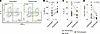 Figure 4
Dupilumab promotes IFN-γ production in individuals with Th2 skewing. (A) Representative examples of cytokine production by CD4+ T cells cultured in vitro with or without dupilumab. (B–D) Effect of dupilumab treatment on percentage IFN-γ+ cells (B), percentage IL-4+ cells (C), or Th2/Th1 ratio (D) (Wilcoxon’s signed-rank exact test).
Patients with defects in Type-1 immunity are known to be susceptible to severe coccidioidomycosis (6). To determine whether deleterious alleles in the IL-12/IFN-γ axis were enriched in our cohort of Th2-skewed patients, we employed whole-genome sequencing (WGS). Both genomic data and cytokine profiling were collected for 180 patients. For this analysis, we studied those with a Th2/Th1 ratio of 1.0 or greater to avoid missing interesting edge cases. Among the DCM patients with a Th2 phenotype, we found 6 rare, interesting missense variants (Table 2). One, IL12RB1 G447A, occurs with an allele frequency of 3.7 × 10⁻⁶ in gnomAD v4 and is predicted to be pathogenic by CADD, SIFT, PolyPhen, and ESM1b. Another, IFNGR1 P431L, occurs with an allele frequency of 3.8 × 10⁻⁵ and is listed as a variant of uncertain significance in a ClinVar entry for disseminated atypical mycobacterial infection. We tested both rare variants in functional assays of cytokine signaling. Both B cells and monocytes from the patient with a P431L variant in IFNGR1 had normal levels of Stat1 protein (Figure 5A) but showed a hypomorphic response in the phosphorylation of Stat1 upon stimulation with IFN-γ (Figure 5, B and C). Cells from the patient with a G447A variant in IL12RB1 responded normally to IL-12 stimulation, as measured by phosphorylation of Stat4 (Supplemental Figure 5). These results demonstrate the feasibility of identifying rare variants in signaling pathways critical for Type-1 immunity in patients with Th2-skewed CD4+ T cells.
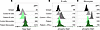 Figure 5
Validation of a rare variant in IFNGR1 in a Th2-skewed patient with DCM. A heterozygous P431L variant in IFNGR1 in a Th2-skewed patient with coccidioidomycosis (“Patient”) results in a hypomorphic response to IFN-γ. (A) Total Stat1 levels in control and patient B cells and monocytes. (B and C) Measurement of phosphorylation of Stat1 in response to IFN-γ stimulation shows a defective response in patient B cells (B) and monocytes (C). The geometric mean fluorescence intensities for all peaks are shown.


