
Abstract
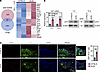
Chronic, non-healing wounds are a severe diabetic complication. The underlying mechanisms are not fully understood, and the role of ATF7 in this context has not been well characterized. In our study, we utilized db/db diabetic mice and AAV-mediated keratinocyte-specific Atf7 overexpression in vivo. HaCaT keratinocyte/THP-1 macrophage cocultures under high glucose were used in vitro. Our results showed that ATF7 was upregulated in diabetic wounds. Keratinocyte-specific Atf7 overexpression accelerated diabetic wound closure, enhanced re-epithelialization, granulation tissue formation, and keratinocyte proliferation, while suppressing macrophage M1 polarization and inflammation. Multiomics screening identified NOTCH1 as a key ATF7 target. ATF7 transcriptionally repressed NOTCH1 by recruiting Suv39h1, increasing H3K9me3 at the NOTCH1 promoter. This reduced NOTCH1 protein and its active intracellular domain (N1ICD) within keratinocyte-derived exosomes. ATF7-overexpressing keratinocyte exosomes carried less N1ICD, leading to decreased N1ICD transfer to macrophages and subsequent inhibition of M1 polarization. Notably, local injection of exosomes from ATF7-overexpressing keratinocytes accelerated wound healing in db/db mice. In summary, ATF7 promotes diabetic wound healing by repressing NOTCH1 transcription via H3K9me3, thereby reducing exosomal N1ICD secretion from keratinocytes and inhibiting macrophage M1 polarization. This identifies the ATF7/NOTCH1/exosome axis as a therapeutic target.
Authors
Pengcheng Xu, Yuan Xue, Linlin Feng, Jingwen Kuang, Xiaochen Hu, Huiyi Tang, Biao Cheng, Limin Wei
This file is in Adobe Acrobat (PDF) format. If you have not installed and configured the Adobe Acrobat Reader on your system.
Having trouble reading a PDF?
PDFs are designed to be printed out and read, but if you prefer to read them online, you may find it easier if you increase the view size to 125%.
Having trouble saving a PDF?
Many versions of the free Acrobat Reader do not allow Save. You must instead save the PDF from the JCI Online page you downloaded it from. PC users: Right-click on the Download link and choose the option that says something like "Save Link As...". Mac users should hold the mouse button down on the link to get these same options.
Having trouble printing a PDF?
- Try printing one page at a time or to a newer printer.
- Try saving the file to disk before printing rather than opening it "on the fly." This requires that you configure your browser to "Save" rather than "Launch Application" for the file type "application/pdf", and can usually be done in the "Helper Applications" options.
- Make sure you are using the latest version of Adobe's Acrobat Reader.


