
Submit a comment
Abstract
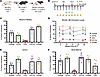
Mixed hematopoietic chimerism after hematopoietic cell transplantation (HCT) can modulate the immune system and induce tolerance to allogeneic tissues. However, bone marrow conditioning–related toxicities preclude wider adoption of HCT for transplant allotolerance. We sought agents that reduced conditioning intensity, while promoting durable mixed chimerism after HCT across complete MHC mismatch in diabetic mice, permitting islet allotransplantation and diabetes reversal. We systematically tested baricitinib (JAK1/2 inhibitor), venetoclax (Bcl-2 inhibitor), and CD47 antibody, agents in current clinical use, and quantified hematopoietic chimerism after HCT. Combined with CD117 antibody, transient T cell depletion, and just 10 centigray total body irradiation, these agents enabled durable mixed chimerism and matching alloislet tolerance to cure diabetes without evidence of graft-versus-host disease. Thus, we have developed a conditioning regimen to promote allogeneic mixed hematopoietic chimerism and transplanted islet allotolerance that minimizes conditioning radiation and cures diabetes.
Authors
Stephan A. Ramos, Preksha Bhagchandani, Diego M. Burgos, Xueying Gu, Richard Rodriguez, Nadia Nourin, Martin Neukam, Shiva Pathak, Judith A. Shizuru, Seung K. Kim
Guidelines
The Editorial Board will only consider comments that are deemed relevant and of interest to readers. The Journal will not post data that have not been subjected to peer review; or a comment that is essentially a reiteration of another comment.
- Comments appear on the Journal’s website and are linked from the original article’s web page.
- Authors are notified by email if their comments are posted.
- The Journal reserves the right to edit comments for length and clarity.
- No appeals will be considered.
- Comments are not indexed in PubMed.
Specific requirements
- Maximum length, 400 words
- Entered as plain text or HTML
- Author’s name and email address, to be posted with the comment
- Declaration of all potential conflicts of interest (even if these are not ultimately posted); see the Journal’s conflict-of-interest policy
- Comments may not include figures


