
Submit a comment
Abstract
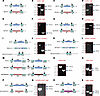
To radically diminish tuberculosis (TB) incidence and mortality by 2035, as set out by the WHO End TB Strategy, there is a desperate need for improved TB therapies and a more effective vaccine against the deadly pathogen Mycobacterium tuberculosis. Aerosol vaccination with the MtbΔsigH mutant protects 2 species of nonhuman primates against lethal TB challenge by invoking vastly superior T and B cell responses in the lungs through superior antigen presentation and interferon conditioning. Since the Geneva Consensus on essential steps toward the development of live mycobacterial vaccines recommends that live TB vaccines incorporate at least 2 independent gene knockouts, we have now generated several rationally designed, double-knockout (DKO) and triple-knockout (TKO) mutants in Mtb, each containing the ΔsigH deletion. Here, we report preclinical studies in the rhesus macaque model of aerosol infection and SIV/HIV coinfection, aimed at assessing the safety of these MtbΔsigH-based DKOs and TKOs. We found that most of these mutant strains were attenuated in both immunocompetent and SIV-coinfected macaques, and combinatorial infection with these generated strong cellular immune responses in the lung, akin to MtbΔsigH. Aerosol infection with these KO strains elicited inducible bronchus-associated lymphoid tissue, which is a correlate of protection from TB.
Authors
Garima Arora, Caden W. Munson, Mushtaq Ahmed, Vinay Shivanna, Annu Devi, Venkata S.R. Devireddy, Basil Antony, Shannan Hall-Ursone, Olga D. Gonzalez, Edward J. Dick Jr., Chinnaswamy Jagannath, Xavier Alvarez, Smriti Mehra, Shabaana A. Khader, Dhiraj K. Singh, Deepak Kaushal
Guidelines
The Editorial Board will only consider comments that are deemed relevant and of interest to readers. The Journal will not post data that have not been subjected to peer review; or a comment that is essentially a reiteration of another comment.
- Comments appear on the Journal’s website and are linked from the original article’s web page.
- Authors are notified by email if their comments are posted.
- The Journal reserves the right to edit comments for length and clarity.
- No appeals will be considered.
- Comments are not indexed in PubMed.
Specific requirements
- Maximum length, 400 words
- Entered as plain text or HTML
- Author’s name and email address, to be posted with the comment
- Declaration of all potential conflicts of interest (even if these are not ultimately posted); see the Journal’s conflict-of-interest policy
- Comments may not include figures


