
Submit a comment
Abstract
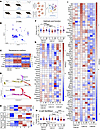
Cellular senescence is an irreversible stress response, which leads to loss of cellular function and remodeling of the cellular secretory profile. In humans, pancreatic β cells undergo cellular senescence during the progression to type 2 diabetes (T2D). However, the mechanism linking β cell senescence to islet dysfunction remains unknown, and thus the therapeutic potential of targeting senescent cells in T2D is not established. Herein, we identified a subpopulation of senescent β cells expressing p21, which emerged early in the progression of T2D in humans and mice. Spatial transcriptomics and proteomics analyses confirmed senescence and loss of cellular identity in this subpopulation in humans. Functional analysis revealed lack of glucose responsiveness, high basal insulin secretion, and transcription of senescence-associated secretory phenotype (SASP) factors. SASP factors from p21+ β cells induced secondary senescence in neighboring cells, characterized by dysfunction and loss of identity. JAK inhibitors counteracted the induction of secondary senescence and restored β cell function in islets from humans with T2D and in mice fed a high-fat diet. These findings reveal the critical role of p21+ β cells in T2D pathogenesis and the therapeutic potential of targeting this pathophysiological process.
Authors
Kanako Iwasaki, Priscila Carapeto, Cristian Abarca, Francesko Hela, Stephanie Sanjines, Sebastian Pena, Sandra Le, Hui Pan, Maya Jackson, Christopher Cahill, Ayush Midha, Juliana Alcoforado Diniz, Dylan Baker, Sergii Domanskyi, Sara Espinoza, Alejandro Peña, Francisco G. Cigarroa, Jillian L. Woodworth, Jeffrey H. Chuang, Vesna D. Garovic, James L. Kirkland, Tamara Tchkonia, Nicolas Musi, George A. Kuchel, Paul Robson, Cristina Aguayo-Mazzucato
Guidelines
The Editorial Board will only consider comments that are deemed relevant and of interest to readers. The Journal will not post data that have not been subjected to peer review; or a comment that is essentially a reiteration of another comment.
- Comments appear on the Journal’s website and are linked from the original article’s web page.
- Authors are notified by email if their comments are posted.
- The Journal reserves the right to edit comments for length and clarity.
- No appeals will be considered.
- Comments are not indexed in PubMed.
Specific requirements
- Maximum length, 400 words
- Entered as plain text or HTML
- Author’s name and email address, to be posted with the comment
- Declaration of all potential conflicts of interest (even if these are not ultimately posted); see the Journal’s conflict-of-interest policy
- Comments may not include figures


