
Submit a comment
Abstract
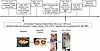
We hypothesized that bone marrow transplantation (BMT) using marrow extracted from the vertebral bodies (VBs) of an unrelated deceased lung transplant donor would be able to establish persistent hematopoiesis and generate immunity and tolerance. A teenager with severe combined immunodeficiency with lung failure due to recurrent pneumonias underwent lung transplantation in 2016 from a 1/8 HLA allele–matched unrelated donor, followed by BMT 4 months later using T cell/B cell–depleted, cryopreserved VB marrow. Rapid engraftment was followed by accelerating immune competence at 6 months, with independence from immunosuppression by 16 months. Donor T cell (>95%) and myeloid chimerism (7%–10%) has persisted for over 9 years. At 2 years after BMT, circulating T cells were hyporesponsive to host dendritic cells in vitro. T cell receptor clonotyping revealed the disappearance of host-reactive clones, and T cell RNA sequencing exhibited downmodulated signaling pathways for cytotoxicity/rejection, paired with upregulated immunomodulatory pathways, suggesting active suppression. In parallel, host monocytes upregulated certain signaling pathways, indicating active interactions between post-thymic donor T cells and host monocytes. In summary, for the first time to our knowledge, durable hematopoietic engraftment, immunity, and tolerance were demonstrable in a recipient of BMT obtained from a VB graft.
Authors
Paul Szabolcs, Xiaohua Chen, Marian G. Michaels, Memphis Hill, Evelyn Garchar, Zarreen Amin, Heather M. Stanczak, Shawna McIntyre, Aleksandra Petrovic, Dhivyaa Rajasundaram, Ansuman Chattopadhyay, Jonathan E. Spahr, Peter D. Wearden, Geoffrey Kurland
Guidelines
The Editorial Board will only consider comments that are deemed relevant and of interest to readers. The Journal will not post data that have not been subjected to peer review; or a comment that is essentially a reiteration of another comment.
- Comments appear on the Journal’s website and are linked from the original article’s web page.
- Authors are notified by email if their comments are posted.
- The Journal reserves the right to edit comments for length and clarity.
- No appeals will be considered.
- Comments are not indexed in PubMed.
Specific requirements
- Maximum length, 400 words
- Entered as plain text or HTML
- Author’s name and email address, to be posted with the comment
- Declaration of all potential conflicts of interest (even if these are not ultimately posted); see the Journal’s conflict-of-interest policy
- Comments may not include figures


