
Submit a comment
Abstract
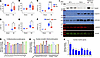
Mitochondrial dysfunction devastates the heart in major cardiovascular diseases, yet the mechanisms governing mitochondrial quality control remain elusive. We discovered that TIGAR (TP53-induced glycolysis and apoptosis regulator) deficiency established profound cardiac protection through developmental epigenetic programming of Parkin expression. Using mice with whole-body and cardiomyocyte-specific TIGAR knockout, we demonstrated remarkable cardioprotection following myocardial infarction with maintained ejection fraction, and complete resistance to diet-induced cardiac hypertrophy despite comparable weight gain. TIGAR deficiency triggered dramatic increases in Parkin expression across all somatic tissues except testes, where Parkin levels remained extraordinarily high (100-fold greater than cardiac levels) regardless of TIGAR status, revealing tissue-specific regulatory mechanisms. This protection was entirely Parkin dependent, as double-knockout mice lost all cardioprotective benefits. Crucially, adult TIGAR manipulation failed to alter Parkin levels, demonstrating that this pathway operated exclusively during critical developmental windows to program lifelong cardiac resilience. Whole-genome bisulfite sequencing identified reduced DNA methylation in Prkn intron 10 as the key regulatory mechanism, with CRISPR deletion dramatically increasing Parkin expression in multiple cell lines. Our findings reveal how early cardiac metabolism programs lifelong cardiac function through epigenetic mechanisms, and identify developmental metabolic programming as a potential therapeutic target for preventing both ischemic heart disease and metabolic cardiomyopathy.
Authors
Yan Tang, Stanislovas S. Jankauskas, Li Liu, Xujun Wang, Alus M. Xiaoli, Fajun Yang, Gaetano Santulli, Daorong Feng, Jeffrey E. Pessin
Guidelines
The Editorial Board will only consider comments that are deemed relevant and of interest to readers. The Journal will not post data that have not been subjected to peer review; or a comment that is essentially a reiteration of another comment.
- Comments appear on the Journal’s website and are linked from the original article’s web page.
- Authors are notified by email if their comments are posted.
- The Journal reserves the right to edit comments for length and clarity.
- No appeals will be considered.
- Comments are not indexed in PubMed.
Specific requirements
- Maximum length, 400 words
- Entered as plain text or HTML
- Author’s name and email address, to be posted with the comment
- Declaration of all potential conflicts of interest (even if these are not ultimately posted); see the Journal’s conflict-of-interest policy
- Comments may not include figures


