
Submit a comment
Abstract
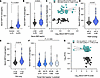
Pulmonary fibrosis is frequently accompanied by pulmonary hypertension, which can occur disproportionate to the extent of fibrosis, suggesting a fibrosis-independent vascular remodeling process. Here, we demonstrated that plasma growth differentiation factor 15 (GDF15) is elevated across diverse fibrotic lung disease subtypes and correlates with markers of elevated right heart pressures but not pulmonary function indices, indicating a possible link to endothelial cell dysfunction. To investigate the import of endothelial GDF15 as a modifier of lung fibrosis pathogenesis, we generated endothelial cell–specific Gdf15-KO mice, which showed protection from bleomycin-induced lung injury and fibrosis, with preserved lung function. RNA-seq of human pulmonary microvascular endothelial cells revealed altered expression of barrier-regulatory genes in GDF15-deficient endothelial cells compared with controls. Functional studies confirmed that GDF15 knockdown attenuates thrombin-induced barrier disruption by reducing cytosolic Ca2+ responses. Together, these findings implicate endothelial GDF15 as a modifier of vascular permeability and Ca2+ signaling and a contributor to lung injury and fibrosis.
Authors
Kristen Raffensperger, Marta Bueno, Brian J. Philips, Megan Miller, Máté Katona, Shuai Yuan, Adriana Estrada-Bernal, Byron Chuan, Pavan Suresh, Stephanie Taiclet, Scott Hahn, Yingze Zhang, Jonathan K. Alder, Seyed Mehdi Nouraie, Daniel J. Kass, Oliver Eickelberg, Adam C. Straub
Guidelines
The Editorial Board will only consider comments that are deemed relevant and of interest to readers. The Journal will not post data that have not been subjected to peer review; or a comment that is essentially a reiteration of another comment.
- Comments appear on the Journal’s website and are linked from the original article’s web page.
- Authors are notified by email if their comments are posted.
- The Journal reserves the right to edit comments for length and clarity.
- No appeals will be considered.
- Comments are not indexed in PubMed.
Specific requirements
- Maximum length, 400 words
- Entered as plain text or HTML
- Author’s name and email address, to be posted with the comment
- Declaration of all potential conflicts of interest (even if these are not ultimately posted); see the Journal’s conflict-of-interest policy
- Comments may not include figures


