
Submit a comment
Abstract
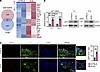
Chronic, non-healing wounds are a severe diabetic complication. The underlying mechanisms are not fully understood, and the role of ATF7 in this context has not been well characterized. In our study, we utilized db/db diabetic mice and AAV-mediated keratinocyte-specific Atf7 overexpression in vivo. HaCaT keratinocyte/THP-1 macrophage cocultures under high glucose were used in vitro. Our results showed that ATF7 was upregulated in diabetic wounds. Keratinocyte-specific Atf7 overexpression accelerated diabetic wound closure, enhanced re-epithelialization, granulation tissue formation, and keratinocyte proliferation, while suppressing macrophage M1 polarization and inflammation. Multiomics screening identified NOTCH1 as a key ATF7 target. ATF7 transcriptionally repressed NOTCH1 by recruiting Suv39h1, increasing H3K9me3 at the NOTCH1 promoter. This reduced NOTCH1 protein and its active intracellular domain (N1ICD) within keratinocyte-derived exosomes. ATF7-overexpressing keratinocyte exosomes carried less N1ICD, leading to decreased N1ICD transfer to macrophages and subsequent inhibition of M1 polarization. Notably, local injection of exosomes from ATF7-overexpressing keratinocytes accelerated wound healing in db/db mice. In summary, ATF7 promotes diabetic wound healing by repressing NOTCH1 transcription via H3K9me3, thereby reducing exosomal N1ICD secretion from keratinocytes and inhibiting macrophage M1 polarization. This identifies the ATF7/NOTCH1/exosome axis as a therapeutic target.
Authors
Pengcheng Xu, Yuan Xue, Linlin Feng, Jingwen Kuang, Xiaochen Hu, Huiyi Tang, Biao Cheng, Limin Wei
Guidelines
The Editorial Board will only consider comments that are deemed relevant and of interest to readers. The Journal will not post data that have not been subjected to peer review; or a comment that is essentially a reiteration of another comment.
- Comments appear on the Journal’s website and are linked from the original article’s web page.
- Authors are notified by email if their comments are posted.
- The Journal reserves the right to edit comments for length and clarity.
- No appeals will be considered.
- Comments are not indexed in PubMed.
Specific requirements
- Maximum length, 400 words
- Entered as plain text or HTML
- Author’s name and email address, to be posted with the comment
- Declaration of all potential conflicts of interest (even if these are not ultimately posted); see the Journal’s conflict-of-interest policy
- Comments may not include figures


