
Abstract
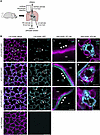
CFTR in the lung epithelium contributes to the secretion of a surface liquid layer that is essential to lung homeostasis and defense. The understanding of how liquid is secreted in the lung is derived largely from studies of the airway epithelium. Comparatively little is known about liquid secretion mechanisms in the alveolar epithelium, including its cellular source. To define which cell type drives alveolar liquid secretion, we generated transgenic mice that expressed a Cftr-null allele in alveolar type 1 (AT1) cells, type 2 (AT2) cells, or both, then viewed liquid secretion in live alveoli using confocal microscopy of isolated, perfused lungs. Our findings show that liquid secretion was blocked in alveoli of all 3 transgenic mice, indicating that both AT1 and AT2 cells contribute to alveolar liquid secretion. Cftr-null expression in AT1 cells also blocked the secretion-mediated clearance of small particle and bacterial clusters from alveolar walls, indicating that AT1 cell CFTR contributes to alveolar defense. Together, these findings show alveolar liquid secretion depends on both AT1 and AT2 cell CFTR, and that CFTR in AT1 cells — a cell type not traditionally considered in liquid secretion mechanisms or CFTR-related lung diseases — contributes to lung liquid dynamics and host defense.
Authors
Sayahi Suthakaran, Sonya Homami, Deebly Chavez, Stephanie Tang, Sarah K.L. Moore, Chaya Sussman, Jimmy Zhang, Clemente J. Britto, Alice Prince, Alison J. May, Jaymin J. Kathiriya, Jaime L. Hook
This file is in Adobe Acrobat (PDF) format. If you have not installed and configured the Adobe Acrobat Reader on your system.
Having trouble reading a PDF?
PDFs are designed to be printed out and read, but if you prefer to read them online, you may find it easier if you increase the view size to 125%.
Having trouble saving a PDF?
Many versions of the free Acrobat Reader do not allow Save. You must instead save the PDF from the JCI Online page you downloaded it from. PC users: Right-click on the Download link and choose the option that says something like "Save Link As...". Mac users should hold the mouse button down on the link to get these same options.
Having trouble printing a PDF?
- Try printing one page at a time or to a newer printer.
- Try saving the file to disk before printing rather than opening it "on the fly." This requires that you configure your browser to "Save" rather than "Launch Application" for the file type "application/pdf", and can usually be done in the "Helper Applications" options.
- Make sure you are using the latest version of Adobe's Acrobat Reader.


