
Submit a comment
Abstract
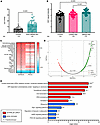
Dermal fibrosis is a cardinal feature of systemic sclerosis (SSc) for which there are limited effective disease-modifying therapies. SSc is characterized by dermal fibrosis accompanied by loss of dermal white adipose tissue (DWAT), yet the mechanisms linking adipocyte depletion to fibroblast activation remain unclear. Here we identify the transcription factor SIX1 as a central regulator coupling adipogenic repression with profibrotic signaling. SIX1 expression was increased in skin biopsies from 2 independent SSc cohorts and localized to fibroblast and perivascular stromal cells. In mice, ubiquitous or adipocyte-specific deletion of Six1 preserved DWAT, reduced collagen accumulation, and selectively decreased profibrotic mediators. In cultured fibroblasts, CRISPR/Cas9-mediated Six1 loss enhanced adipogenic markers while reducing profibrotic mediators and directly suppressed PAI-1 (SERPINE1) promoter activity. Together, these data position SIX1 as a transcriptional switch that promotes adipocyte reprogramming and fibrotic progression, and they highlight SIX1 inhibition as a potential therapeutic strategy to preserve adipocyte identity and limit dermal fibrosis.
Authors
Nancy Wareing, Tingting W. Mills, Scott Collum, Minghua Wu, Lucy Revercomb, René A. Girard, Hui Liu, Alexes Daquinag, Mikhail Kolonin, Marka Lyons, Brian Skaug, Weizhen Bi, Meer A. Ali, Haniyeh Koochak, Anthony R. Flores, Yuntao Yang, W. Jim Zheng, William R. Swindell, Shervin Assassi, Harry Karmouty-Quintana
Guidelines
The Editorial Board will only consider comments that are deemed relevant and of interest to readers. The Journal will not post data that have not been subjected to peer review; or a comment that is essentially a reiteration of another comment.
- Comments appear on the Journal’s website and are linked from the original article’s web page.
- Authors are notified by email if their comments are posted.
- The Journal reserves the right to edit comments for length and clarity.
- No appeals will be considered.
- Comments are not indexed in PubMed.
Specific requirements
- Maximum length, 400 words
- Entered as plain text or HTML
- Author’s name and email address, to be posted with the comment
- Declaration of all potential conflicts of interest (even if these are not ultimately posted); see the Journal’s conflict-of-interest policy
- Comments may not include figures


